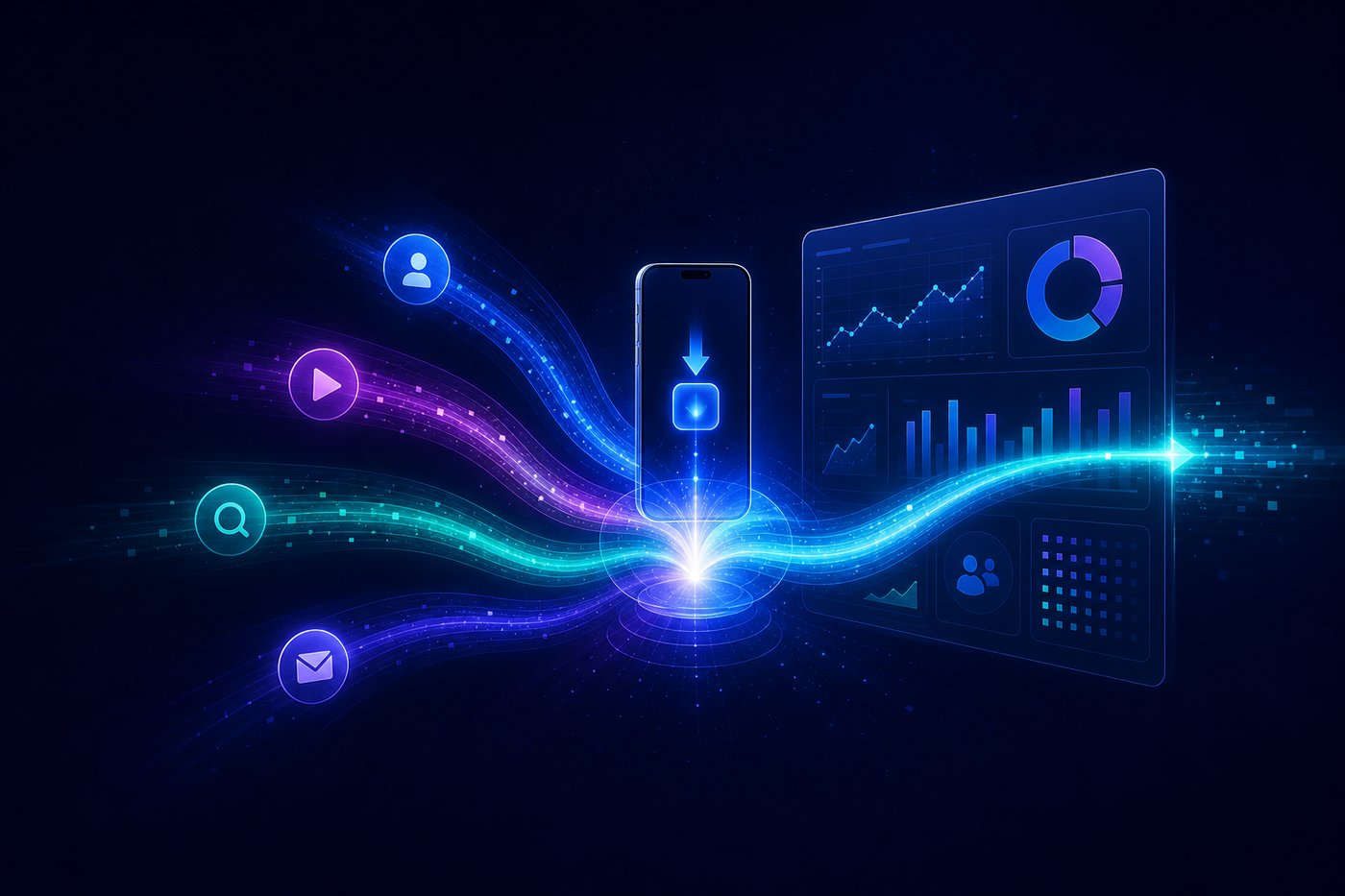
Link Tracking for Ad Campaigns: UTMs & Smart Links 2026

What is link tracking?
Link tracking is the practice of attaching data to the URLs in your ads, emails, and social posts so that every click can be tied back to the exact campaign, channel, and creative that produced it. Done well, it answers the only question that matters in paid media: which spend actually made money? Done poorly — or not at all — your analytics shows a wall of "direct" and "referral" traffic and you are left guessing which ad drove the sale.
In 2026, link tracking is no longer just about appending a few tags to a URL. Privacy changes, ad blockers, and the shift to mobile and in-app destinations have turned it into a discipline that spans UTM parameters, smart links, deep links, and server-side attribution. This guide walks through each layer and shows how they fit together.
The anatomy of a tracked link: UTM parameters
The most common form of link tracking is the UTM parameter — five small tags appended to a URL that your analytics platform reads to attribute the visit:
utm_source — where the click came from (
facebook,google,newsletter)utm_medium — the channel type (
cpc,paid_social,email)utm_campaign — the campaign name (
summer_launch_2026)utm_content — which creative or variant (
video_a,blue_button)utm_term — the paid keyword (optional, mostly for search)
A finished tracked link looks like this:
https://yoursite.com/offer?utm_source=facebook&utm_medium=paid_social&utm_campaign=summer_launch_2026&utm_content=video_a
The single biggest mistake teams make is inconsistent naming. Facebook, facebook, and FB are three different sources to your analytics, and they will fragment your reports. Lock down a lowercase naming convention, keep it in a shared spreadsheet or a link-building tool, and never let people hand-type UTMs into the browser bar.
Click tracking vs. conversion tracking
These two get confused constantly, so it is worth being precise:
Click tracking records the tap — who clicked, from which link, at what time.
Conversion tracking records what happened after the click — a signup, a purchase, an install.
A tracked link gives you the click. To close the loop you also need the conversion event fired back with the same campaign identifiers attached. The whole point of link tracking is to make those two halves meet, so that "10,000 clicks" becomes "10,000 clicks → 420 signups → 38 paying customers from the summer_launch_2026 campaign."
Why client-side link tracking is breaking in 2026
For years, tracking ran inside the visitor's browser using JavaScript pixels and third-party cookies. That pipeline is now leaky on every side:
Ad blockers strip tracking scripts before they ever fire.
Apple's Intelligent Tracking Prevention caps the lifetime of cookies set by client-side scripts.
iOS App Tracking Transparency (ATT) restricts the cross-app identifiers attribution used to rely on.
Browsers continue to phase down third-party cookies entirely.
The practical result is under-reporting: your ad platform claims more conversions than your analytics can see, the numbers never reconcile, and you optimize budget on bad data. If your tracking still lives entirely in the browser, you are flying with a broken instrument.
Server-side, first-party link tracking (the 2026 standard)
Server-side tracking moves the work out of the browser and onto infrastructure you control. Your server reads the UTM parameters on the first visit, stores them in a first-party cookie, and forwards the data to your analytics and CRM — before ad blockers or browser restrictions can interfere. Because the UTM data captured on that first touch persists through the entire journey, you can attribute a conversion that happens days later back to the original campaign.
Server-side tracking paired with UTMs is widely considered the most complete attribution setup available in 2026, especially for brands running Meta, Google, and email at the same time. It is more reliable, more durable, and far harder for a browser to silently degrade. A purpose-built link platform such as DeepClick handles this capture at the edge so you do not have to build the pipeline yourself.
Smart links: one URL for every device
A smart link is a single URL that detects the visitor's device — iPhone, iPad, Android, or desktop — and routes each one to the correct destination automatically. If your offer lives in an app and the app is not installed, the smart link sends the visitor to the right app store; if it is installed, it can open it directly; on desktop it can fall back to a web page.
This solves a real revenue leak. One generic link sent to a mixed audience dumps iPhone users on an Android page and desktop users on a store listing they cannot use. A smart link removes that friction by making the right routing decision at the moment of the click, which is exactly why web-to-app conversion rates have climbed sharply as smart-link technology has matured.
Deep links and deferred deep linking
A deep link opens a specific screen inside an app — a product, an offer, a checkout — rather than dropping the user on a generic home screen, and it carries the campaign data with it so the in-app action can be attributed to the original click.
Deferred deep linking extends this across an install. When a brand-new user taps your ad, installs the app, and opens it for the first time, deferred deep linking remembers the original destination and sends them straight to the exact offer — instead of a blank home screen. This is one of the highest-leverage tactics for user-acquisition campaigns, and importantly, deep linking for user experience remains permitted regardless of a user's ATT choice, because it relies on first-party signals rather than cross-app tracking.
Link tracking and ad compliance: serving the right page to the right visitor
Paid platforms review the page that sits behind your link, and reviewers, scrapers, and competitors all hit that URL too. A legitimate, common need is to keep your high-intent offer page (the money page) separate from a clean, policy-compliant safe page, and to decide per request — based on signals like geography, device, and traffic source — which experience to serve.
This is page routing, and it is the same engineering primitive that powers smart links and A/B landing-page tests. DeepClick's Shield handles this server-side so your real campaign traffic and your review traffic each get a coherent, truthful experience. Used correctly, it protects a clean campaign from scrapers and keeps your safe page honest — it is not a license to mislead the people who actually click your ad. For a deeper walk-through of the technique and the tools, see our URL cloaking guide for affiliates and the post-click optimization tools comparison.
A 2026 link-tracking checklist
Standardize UTM naming in a shared doc — lowercase, no spaces, one value per concept.
Use a link platform, not hand-built URLs, so tagging is consistent and auditable.
Turn on server-side, first-party capture so ad blockers and ITP stop eating your data.
Add smart links for any campaign that mixes devices or sends to an app.
Add deep links and deferred deep linking for every in-app destination.
Reconcile platform-reported conversions against your own first-party numbers weekly, and trust the first-party set.
FAQ
Is link tracking the same as UTM tracking?
UTMs are the most common method, but link tracking is broader. It also covers click IDs, smart links, deep links, and server-side attribution. UTMs handle channel-level reporting; the rest handle device routing and durable, privacy-safe measurement.
Are UTM parameters still reliable in 2026?
Yes for attributing traffic to a source, medium, and campaign — that logic has not changed. What has changed is that you should capture them server-side on the first visit rather than depending on browser cookies to remember them later.
Does iOS ATT break link tracking?
ATT limits cross-app device identifiers; it does not break first-party link data or deep linking used to improve the user experience. Teams typically run SKAdNetwork for ATT-restricted users and deferred deep linking everywhere else.
What is the difference between a smart link and a deep link?
A smart link decides which destination to send each device to (store, app, or web). A deep link decides which screen inside an app to open once the user is there. Most modern campaigns use both together.
The bottom line
Link tracking in 2026 is a stack, not a tag. UTMs give you the labels, smart links route every device to the right place, deep links carry the context into the app, and server-side first-party capture keeps the whole thing measurable while browsers tighten down. Build all four layers and you stop guessing which ad worked — you know. Explore how DeepClick's Shield and re-engagement tools put this stack to work for paid campaigns.
