Mobile Traffic Attribution: The 2026 Marketer's Guide

What Is Mobile Traffic Attribution?
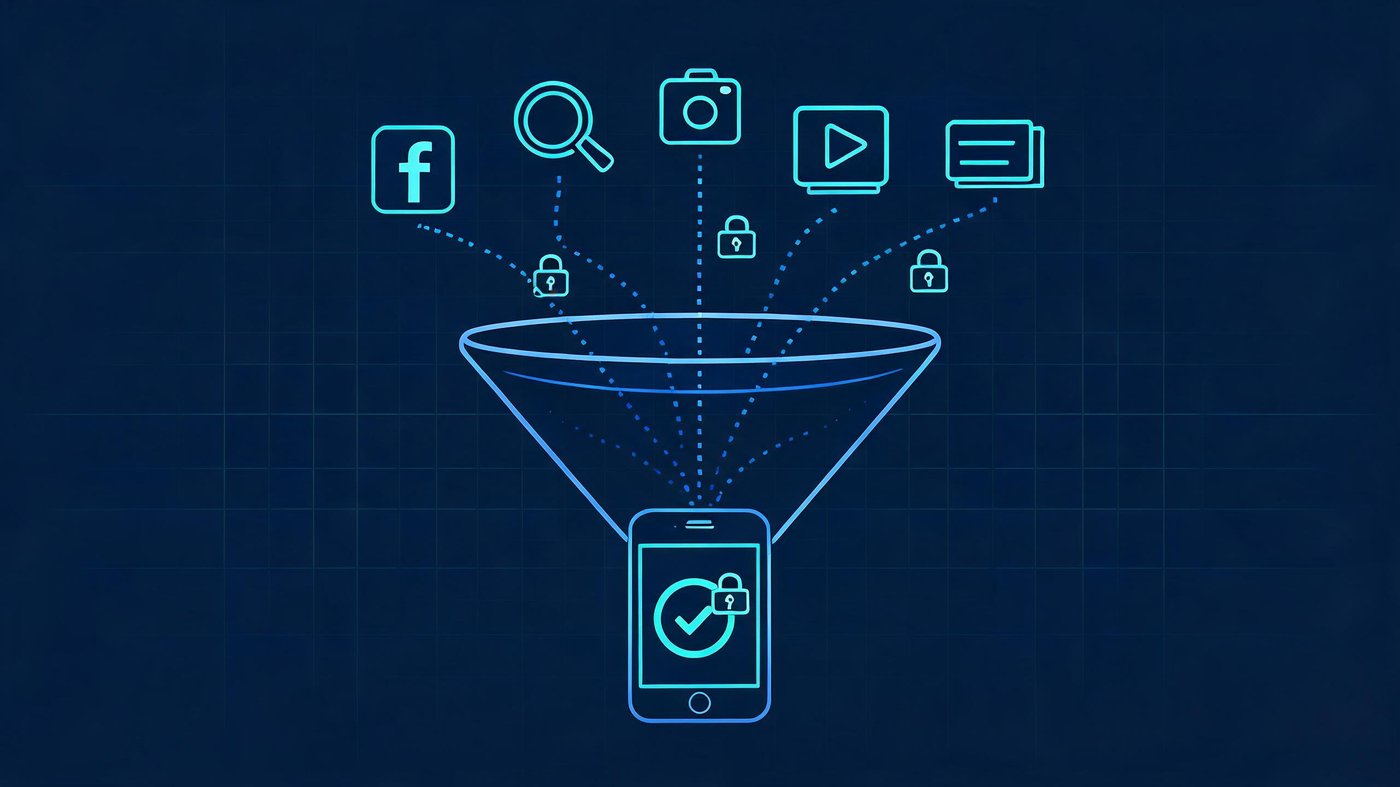
Mobile traffic attribution is the process of connecting a mobile install, event, or conversion back to the specific ad, channel, or campaign that caused it. It answers the single most expensive question in user acquisition: which of my traffic sources actually produced this user? Without attribution, every dollar of ad spend is a guess. With it, you can shift budget toward the campaigns that convert and cut the ones that only look busy.
Attribution sounds simple — click here, install there, connect the two — but on mobile it is genuinely hard. There is no shared cookie between an ad in one app and an install in the store. Privacy frameworks like Apple's App Tracking Transparency (ATT) and Google's Privacy Sandbox have removed or degraded the device identifiers the industry relied on for a decade. Getting mobile traffic attribution right in 2026 means understanding the models, the matching methods, and the failure modes below.
Why Mobile Traffic Attribution Is Harder Than Web
On the web, a pixel and a cookie can follow a user from ad click to purchase. Mobile breaks that chain in three places:
- No cross-app cookies. An ad rendered inside one app and an install completed in the App Store or Google Play live in separate sandboxes. There is no shared browser state to link them.
- Identifier loss. Apple's ATT made the IDFA opt-in, and most users decline. Android's Advertising ID is following a similar path. The deterministic key the industry used is now missing for the majority of traffic.
- Delayed and aggregated signals. Privacy-preserving frameworks such as Apple's SKAdNetwork and its successor AdAttributionKit return conversions late, in coarse buckets, and with a privacy threshold that can suppress low-volume campaigns entirely.
The result: mobile traffic attribution is now a probability problem, not a lookup. The teams that win treat it that way.
The Core Attribution Models
Every attribution decision reduces to a model — a rule for assigning credit when a user touched several channels before converting.
Last-click (last-touch)
Assigns 100% of the credit to the final click before install. Simple, transparent, and still the default in most ad dashboards — but it systematically overcredits bottom-funnel retargeting and undercredits the awareness channels that started the journey.
First-click (first-touch)
Assigns all credit to the first interaction. Useful for measuring discovery, but blind to everything that closed the deal.
Multi-touch
Distributes credit across every touchpoint (linear, time-decay, or position-based). More honest about how users really convert, but hungry for data — and privacy loss makes the full path harder to observe than it was three years ago.
Data-driven
Uses modeling to assign fractional credit based on each touchpoint's measured contribution. The most accurate approach when you have the volume to support it, and increasingly the practical default as deterministic paths disappear.
Deterministic vs. Probabilistic Matching
Underneath the model sits the matching method — how you actually connect a click to an install. The two approaches differ on four dimensions:
- Basis — Deterministic uses an exact identifier (device ID, login); probabilistic uses statistical signals (IP, device type, timestamp, OS).
- Accuracy — Deterministic is very high when identifiers exist; probabilistic is approximate and confidence-scored.
- Privacy exposure — Deterministic is higher because it needs stable IDs; probabilistic is lower because it needs no persistent ID.
- 2026 availability — Deterministic is shrinking under ATT and the Privacy Sandbox; probabilistic is growing as the fallback.
The modern stack blends both: use deterministic matching wherever a consented identifier survives, and fall back to probabilistic modeling for the majority of traffic where it does not. Relying on either alone leaves money on the table.
Attribution Providers and Where DeepClick Fits
Most teams route measurement through a mobile measurement partner (MMP). The best-known options each publish integration docs worth reviewing:
- AppsFlyer — the largest MMP by market share, deep network integrations.
- Adjust — strong fraud-prevention and analytics tooling.
- Branch — deep-linking-first, strong web-to-app journeys.
- Kochava — flexible, transparent data access.
DeepClick complements this layer rather than replacing it. Its PWA install measurement captures the install-and-engagement funnel for progressive web apps — the exact surface that traditional store-based MMPs measure poorly. For advertisers running on the major social channels, the Meta and TikTok advertiser solution ties campaign spend to downstream events, and re-engagement flows extend attribution past the first session into retention. Together they close the gap between "we got an install" and "we got a user who stayed."
How to Set Up Mobile Traffic Attribution: A Practical Sequence
- Define the conversion that matters. Not "install" — the first meaningful action (registration, first purchase, day-7 retention). Attribution is only as useful as the event you anchor it to.
- Choose an MMP or measurement layer and integrate its SDK — or, for PWA and web-to-app flows, a measurement product built for that surface.
- Instrument events consistently across channels so a "purchase" means the same thing everywhere. Inconsistent event definitions are the most common cause of attribution disputes.
- Pick a model deliberately. Start with last-click for transparency, then layer multi-touch or data-driven once you trust your event data.
- Plan for privacy-safe fallbacks. Configure SKAdNetwork / AdAttributionKit and probabilistic modeling so you are not blind on the majority of iOS traffic.
- Audit for fraud. Filter data-center IPs, click-injection, and install farms before they poison your attribution data — bad traffic misattributes and wastes spend.
Frequently Asked Questions
What is mobile traffic attribution in one sentence?
It is the practice of matching a mobile install or in-app event back to the ad, channel, or campaign that drove it, so you can measure and optimize return on ad spend.
What is the difference between deterministic and probabilistic attribution?
Deterministic attribution matches a click to an install using an exact identifier; probabilistic attribution infers the match from statistical signals like IP, device type, and timing. Deterministic is more accurate but requires stable IDs, which privacy frameworks increasingly remove.
Has ATT killed mobile attribution?
No, but it changed it. App Tracking Transparency removed the deterministic IDFA for most users, pushing the industry toward aggregated frameworks (SKAdNetwork / AdAttributionKit) and probabilistic modeling. Attribution is now a probability discipline rather than a simple lookup.
Do I still need an MMP in 2026?
For most app advertisers, yes — an MMP centralizes network integrations and fraud tooling. But for PWA, web-to-app, and re-engagement funnels, you also need measurement built for those surfaces, which is where DeepClick fits.
Key Takeaways
Mobile traffic attribution in 2026 is a probability discipline, not a lookup. Deterministic identifiers are shrinking, so the winning setup blends deterministic and probabilistic matching, picks its attribution model deliberately, and instruments events consistently across every channel. Anchor attribution to the event that actually signals a valuable user, filter fraud aggressively, and extend measurement past the first session with PWA install measurement and re-engagement. Get this right and every future ad dollar goes to the channels that genuinely produce users.
