Social Media Listening Platforms: How They Work and How to Choose (2026)

Social Media Listening Platforms: How They Work and How to Choose (2026)
Social media listening platforms are tools that collect and analyze public conversations across social networks, forums, review sites, and news — so brands can understand what people say about them, their competitors, and their category in near real time. Unlike a scheduler or an inbox tool, a listening platform is built for discovery: surfacing sentiment shifts, emerging topics, and reputation risks you didn't know to search for.
This guide is a plain-English explainer of what social media listening platforms are, how they work under the hood, the main types, and a framework for choosing one. If you want a ranked, priced comparison of specific products instead, see our social listening tools comparison.
What social media listening platforms actually do
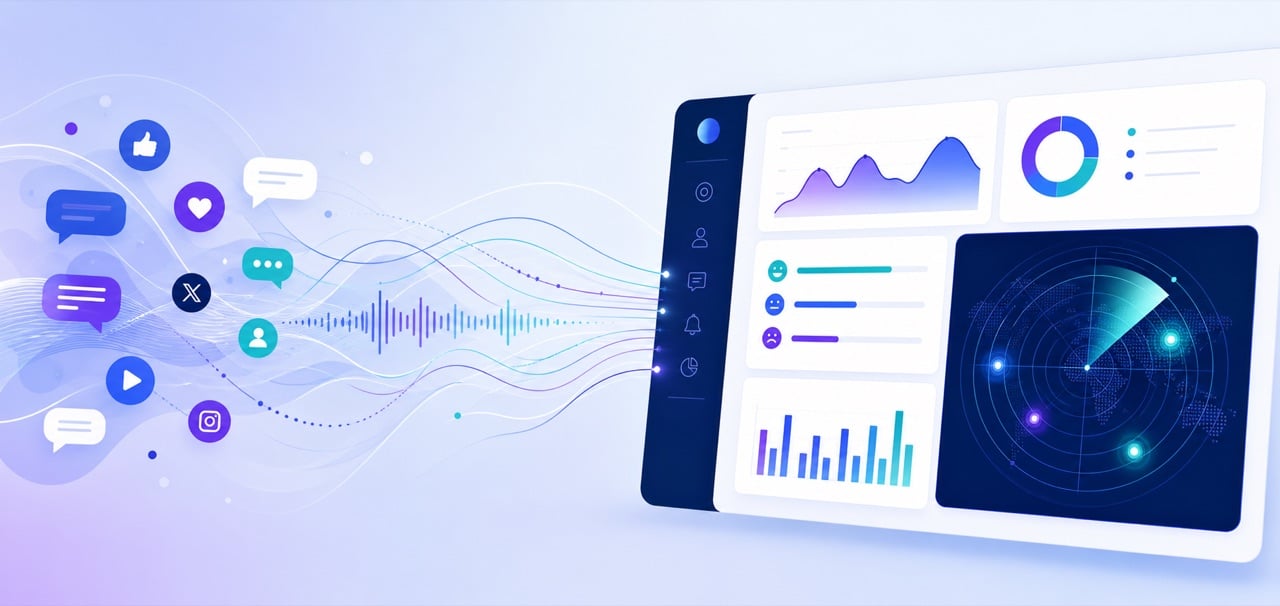
A social media listening platform continuously ingests public posts that match your topics — your brand name, products, competitors, hashtags, or industry terms — and turns that firehose into something a marketer can act on. Four capabilities define the category:
- Coverage — how many sources the platform monitors (X/Twitter, Instagram, TikTok, Reddit, YouTube, forums, blogs, review sites, news).
- Filtering and relevance — how well it separates signal from noise, deduplicates, and removes spam and bots.
- Analysis — sentiment scoring, topic clustering, share of voice, and trend detection.
- Action — alerts, dashboards, and workflows that route findings to the right team.
The distinction people often miss: monitoring answers "what was said about us?", while listening answers "what is happening in our market, and what should we do about it?" The best social media listening platforms do both.
How social media listening platforms work under the hood
Most platforms follow the same four-stage pipeline:
1. Data collection
Platforms pull data through official APIs (where available) and licensed data partners. Coverage and freshness depend heavily on which API partnerships a vendor holds — this is why two tools can show very different volumes for the same query.
2. Processing and enrichment
Raw posts are deduplicated, language-detected, and enriched with metadata (author reach, location, device, source type). Bot and spam filtering happens here; weak filtering is the top reason dashboards feel noisy.
3. Analysis
Natural-language models assign sentiment, cluster posts into topics, and calculate metrics like share of voice and sentiment trend. In 2026, most platforms layer large-language-model summarization on top so you get a paragraph explanation, not just a chart.
4. Delivery
Findings surface as real-time alerts, scheduled reports, and interactive dashboards, often with integrations into Slack, email, or BI tools.
The main types of social media listening platforms
Not every platform is built for the same buyer. Broadly there are four types:
|
Type |
Best for |
Trade-off |
|---|---|---|
|
Enterprise suites |
Large brands needing deep coverage, historical data, and compliance |
Higher cost, longer onboarding |
|
Mid-market all-in-one |
Teams wanting listening plus publishing and engagement |
Listening may be shallower than a specialist |
|
Specialist listening tools |
Analysts who need the deepest query logic and data access |
Fewer publishing/engagement features |
|
Lightweight monitoring apps |
Small teams tracking a handful of keywords |
Limited history and analysis |
If your primary need is tracking brand mentions rather than deep market analysis, a focused monitoring app may be enough — our best social media monitoring tools roundup covers that end of the spectrum, and the monitoring tools pricing comparison breaks down cost.
How to choose a social media listening platform
Work through these questions in order:
- What's the job? Reputation alerts, competitor tracking, campaign measurement, or product/customer insight? Each favors a different tier.
- Which sources matter? If TikTok or Reddit conversation drives your category, confirm the platform has real coverage there — not just a checkbox.
- How good is the filtering? Ask for a trial on your brand terms and judge the signal-to-noise ratio on real data, not a demo query.
- Who acts on it? If findings need to reach non-analysts, prioritize clear dashboards and native alert integrations.
- What's the true cost? Watch for limits on historical data, query volume, and seats — the sticker price rarely tells the whole story.
A useful test: run the same brand query through two or three platforms during trials and compare volume, sentiment accuracy, and how quickly a real spike appears. The differences are often larger than the marketing suggests.
Where listening fits in a paid-social workflow
For performance marketers, listening isn't just brand-safety insurance — it feeds the top of the funnel. Emerging topics and competitor angles surfaced by a listening platform become creative hooks and audience hypotheses. The tighter your loop from insight to campaign to post-click experience, the more that listening pays off. Teams running paid social often pair listening insight with post-click optimization so a trending angle actually converts once the click lands.
Frequently asked questions
What's the difference between social listening and social monitoring? Monitoring tracks direct mentions of your brand and is reactive (respond to what's said). Listening is broader and strategic — analyzing themes, sentiment, and market trends to inform decisions. Most platforms do both, but they lean one way.
Do social media listening platforms see private messages? No. Reputable platforms only analyze public posts and licensed data. They do not access private DMs or non-public content.
How much do social media listening platforms cost? Lightweight tools start low, while enterprise suites run into thousands per month. Cost scales with source coverage, historical data depth, query volume, and seats. See our pricing comparison for concrete ranges.
Can a small team benefit from a listening platform? Yes — start with a focused monitoring app on a few brand and competitor terms, then upgrade to a full listening platform when you need trend and sentiment analysis at scale.
The bottom line
Social media listening platforms turn scattered public conversation into a decision-ready view of your brand and market. Choose based on the job to be done, the sources that matter to you, and — above all — filtering quality tested on your own terms. Trial two or three on real brand queries, compare signal-to-noise, and pick the one whose insights you'd actually act on.
