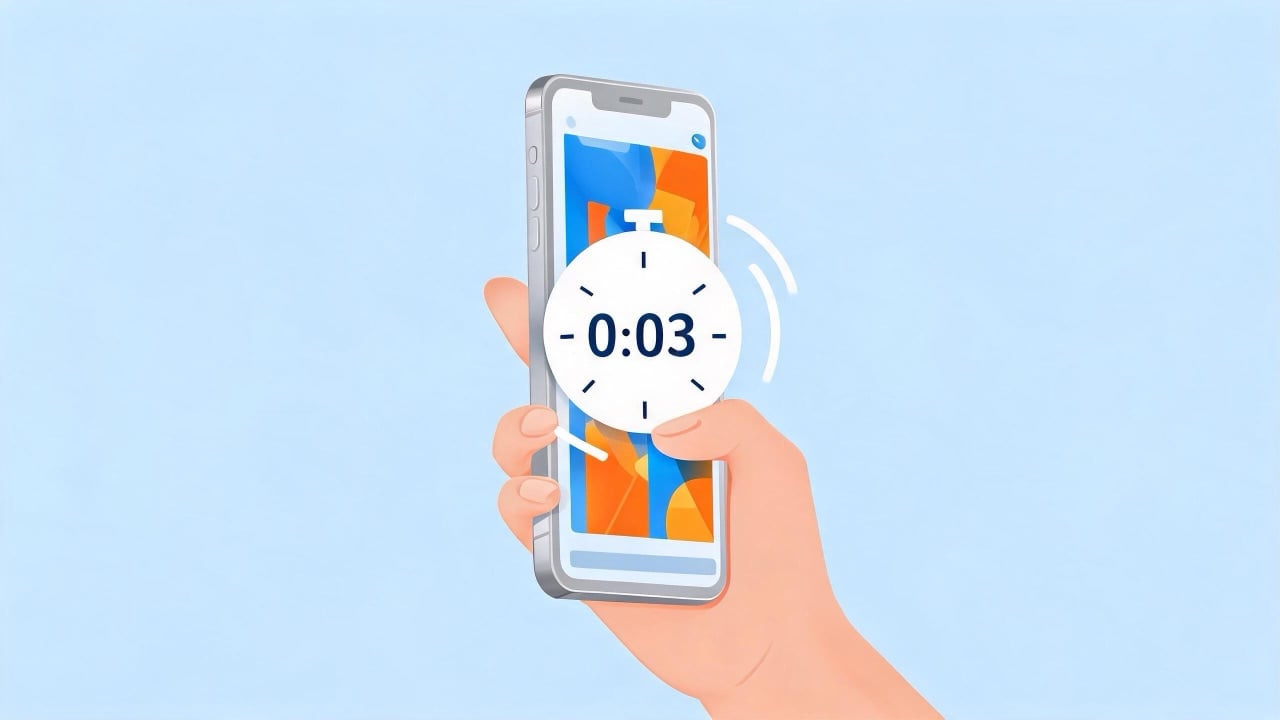
Ad Hook in the First 3 Seconds: Types, Metrics and Tests (2026)

An ad hook is whatever stops the scroll in the first three seconds: the opening frame, the first line of on-screen text, the first sound. If it fails, nothing after it gets watched, so the hook decides whether the rest of the creative ever gets a chance. This guide covers what "first 3 seconds" actually means on each platform, the hook types that hold up in testing, and how to measure a hook separately from the rest of the ad.
Why the ad hook in the first 3 seconds carries the whole ad
Feed environments are scroll-first. A viewer decides whether to stop within a moment, usually with the sound off, and usually before your brand or offer has appeared. That makes the opening a filter rather than an introduction: it determines who sees the message at all.
Two practical consequences follow:
- The hook and the body are different jobs. The hook earns attention; the body converts it. A strong body behind a weak hook produces almost no results, and a strong hook behind a weak body produces cheap views and expensive conversions. Diagnose them separately.
- The hook is the cheapest part to iterate. Re-cutting the first two to three seconds of an existing video costs a fraction of a new shoot, and it is usually where the biggest swings in cost per result come from.
For how the opening interacts with total runtime, see our breakdown of video ad length best practices by platform.
What "first 3 seconds" means on each platform
"Three seconds" is a convention, not a universal rule. Each platform measures early attention a little differently, and your hook metric should follow the platform's own counters.
|
Platform |
Early-attention counter in reporting |
What it means for the hook |
|---|---|---|
|
Meta (Facebook, Instagram) |
3-second video plays; ThruPlays (15 seconds or completion) |
The 3-second play count is the natural numerator for a hook metric |
|
TikTok |
2-second and 6-second video views |
The first two seconds are the stop; six seconds shows whether it held |
|
YouTube skippable in-stream |
Skip button appears after 5 seconds |
The hook has to justify not skipping before the 5-second mark |
On TikTok the window is effectively shorter than three seconds, which is why our TikTok ads creative best practices guide treats the first two seconds as the stop and the first six as the hold.
Seven ad hook types that work in the first 3 seconds
These are patterns, not templates. Each one works because it gives the viewer an immediate reason to keep watching.
- Result first. Open on the outcome (the finished dish, the clean dashboard, the before/after) and explain how afterwards.
- Problem callout. Name the specific pain in plain words on screen: "Your app installs look fine but nobody opens it twice?"
- Pattern interrupt. An unexpected visual, motion or framing that breaks the rhythm of the feed. It must connect to the message within seconds, or it only buys curiosity.
- Direct address. A person looking into the camera and speaking to one viewer. This is the native format of short-form video and the core of most UGC ads.
- Question. A question the target viewer already asks themselves. Avoid rhetorical questions that anyone can answer "no" to.
- Number or list promise. "Three settings to check before you raise budget." It sets a clear expectation of what the viewer will get.
- Product in motion. The product doing its main job in the first frame, without a logo intro or a slow build-up.
Whatever the type, three craft rules apply:
- Design for sound-off. Put the hook in on-screen text as well as in voice-over.
- Front-load the subject. The thing the ad is about should be visible in the first frame, not revealed at second five.
- Keep text inside safe zones. Interface elements cover the top and bottom of vertical placements; a hook hidden under a caption bar does not exist.
How to measure an ad hook: hook rate and hold rate
Most ad platforms do not report a metric called "hook rate", but media buyers commonly derive two ratios from standard columns:
- Hook rate = 3-second video plays ÷ impressions (on TikTok, use 2-second views ÷ impressions). It answers: of everyone who saw the ad, how many stopped?
- Hold rate = ThruPlays ÷ 3-second video plays (on TikTok, 6-second views ÷ 2-second views). It answers: of everyone who stopped, how many stayed?
Reading the two together tells you which part to fix:
|
Hook rate |
Hold rate |
Likely problem |
Next step |
|---|---|---|---|
|
Low |
High |
Opening does not stop the scroll |
Re-cut the first 2–3 seconds only |
|
High |
Low |
Opening over-promises or disconnects from the body |
Make the hook and the first message match |
|
Low |
Low |
Wrong audience or wrong concept |
Revisit the angle before re-editing |
|
High |
High |
Attention is not the bottleneck |
Look at the offer, landing page and post-click flow |
Treat these ratios as diagnostic, not as the goal. A hook that wins on hook rate but attracts the wrong viewers can still lose on cost per result. Compare hooks within the same campaign objective and audience, and confirm the winner on the conversion metric you actually pay for.
How to test hooks without rebuilding the ad
The fastest test isolates the hook as a single variable:
- Keep one proven body and produce three to five versions that differ only in the first two to three seconds.
- Launch them in the same ad set or experiment, with the same audience, placements and budget logic.
- Let each version accumulate enough impressions for the hook rate to stabilise before judging; small samples swing widely.
- Promote the winning opening, then test it against a new set of challengers. Hooks fatigue like any other creative, so plan the next round before performance drops, and watch ad frequency as the audience saturates.
Log every hook with its type (from the list above), so after a few rounds you know which patterns work for your product rather than for advertisers in general.
Common mistakes in the first 3 seconds
- Logo or brand intro first. Branding matters, but an animated logo as the opening frame rarely stops anyone. Bring the brand in once attention is earned, or show the product early instead.
- Slow build-up. Cinematic openings designed for TV give the viewer nothing to react to in a feed.
- Bait-and-switch hooks. An opening unrelated to the product can lift hook rate while lowering hold rate and conversion quality. It can also conflict with platform policies on misleading creative.
- Judging hooks on clicks alone. Click-through rate mixes hook, body and call to action. Use hook and hold rate to locate the problem first.
FAQ
What is a good hook rate for video ads?
There is no universal benchmark worth relying on, because hook rate depends on placement, audience, format and how each platform counts a play. Compare hooks against your own previous creatives in the same campaign and placement, and treat a clear improvement over your baseline as the signal.
Is the 3-second rule the same on TikTok, Meta and YouTube?
No. Meta reports 3-second video plays, TikTok reports 2-second and 6-second views, and on YouTube skippable in-stream ads the skip button appears after five seconds. The idea is the same: the opening must earn the next few seconds. Measure it with each platform's own counter.
Should the brand appear in the first 3 seconds?
Showing the product or brand early helps viewers who drop off still associate the ad with you. The mistake is a slow logo animation that replaces the hook. A product in use, with the brand visible, can do both jobs at once.
How many hooks should I test per ad?
Three to five openings on one proven body is a practical starting point: enough variety to find a pattern, few enough for each version to gather a meaningful sample at a normal budget.
The short version
The ad hook in the first 3 seconds decides whether the rest of the creative is seen at all. Use each platform's own early-view counter, separate hook rate from hold rate, change one opening at a time, and confirm winners on the conversion metric you pay for.
