Domain Cloaking: What It Actually Is, and Why It Is Not Ad Cloaking

What people actually mean by domain cloaking
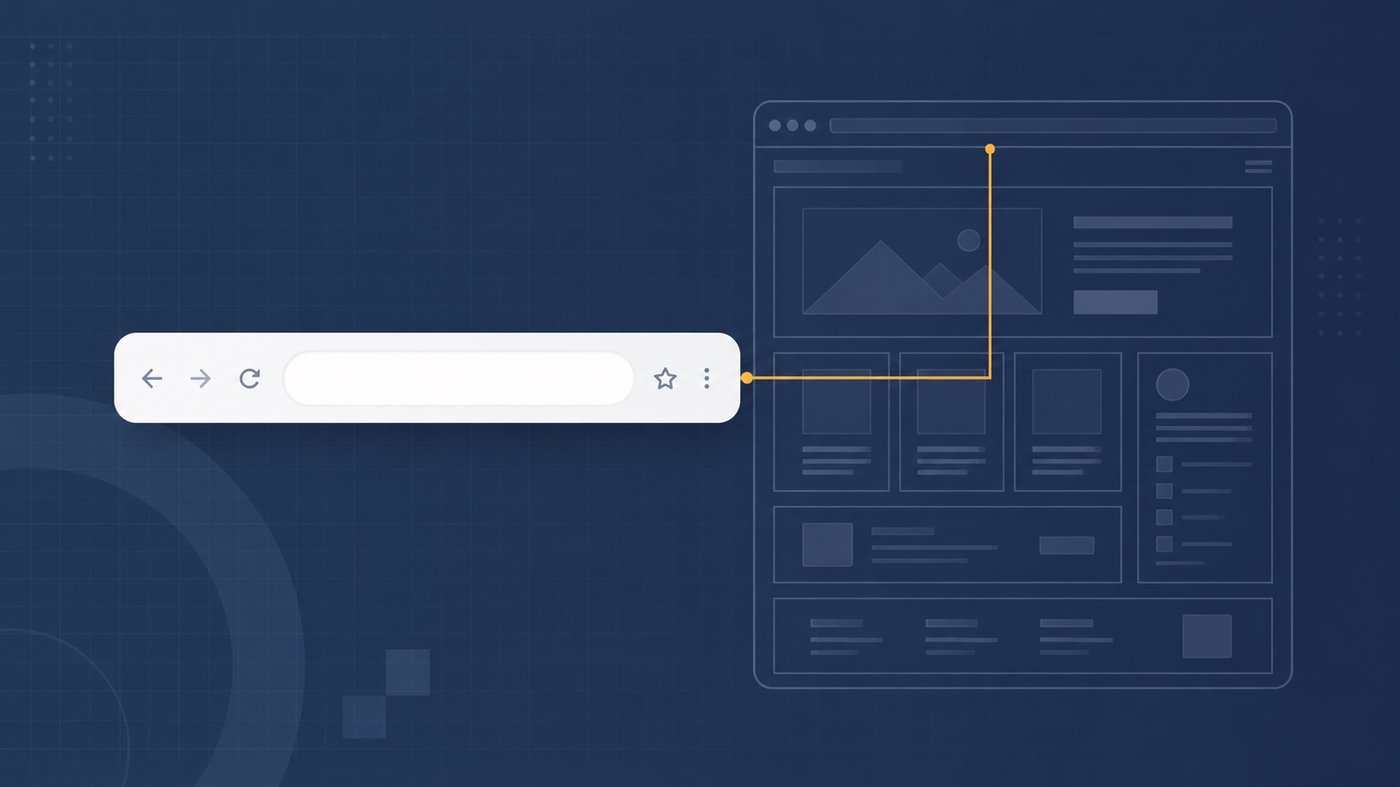
Domain cloaking is a hosting and DNS technique: a domain displays content that lives somewhere else, while the address bar keeps showing the original domain. You type example.com, the page you see is served from realsite.net, and the URL never changes.
Registrars have sold this for two decades under half a dozen names — domain masking, URL masking, cloaked forwarding, stealth redirect, frame forwarding. It is a presentation trick. Every visitor, every crawler, every reviewer gets the same content.
That last sentence is the entire point of this article, because it is what separates domain cloaking from the thing most advertisers are actually asking about.
Three different things share the word "cloaking"
Search for the term and you will land in three unrelated conversations. Keeping them apart saves a lot of wasted effort.
|
Term |
What it does |
Who sees something different |
Where it lives |
|---|---|---|---|
|
Domain cloaking |
Shows another server's content under your domain name |
Nobody — everyone gets the same page |
Registrar / DNS / iframe |
|
URL cloaking |
Hides a long affiliate destination behind a short branded link |
Nobody — it is a redirect, the destination is identical |
Link manager / plugin |
|
Ad cloaking |
Routes traffic to different destinations based on who is asking |
Yes — that is the mechanism |
Traffic routing layer |
Domain cloaking and URL cloaking are both cosmetic. They change what the address bar reads. Ad cloaking is behavioural — it changes where the visitor lands. The three get lumped together because of a shared word, and that confusion regularly sends people to buy the wrong tool.
If you came here because your ad account has a problem, you want the third row. We cover it in Ad Cloaking vs URL Cloaking: The Policy Line in 2026 and, for the mechanics, in What Is Website Cloaking?
How it is actually implemented
There is really only one implementation, and its limitations follow directly from it.
Your registrar serves a tiny HTML document at your domain. That document is a full-page frame pointing at the destination. The browser loads your domain, then loads the destination inside the frame. The address bar shows your domain because that is genuinely the document that was requested.
Some providers dress this up with a <title> tag and a meta description so the framed page has something to show in a tab. That is the whole product.
A few consequences fall straight out of the mechanism:
- The destination can refuse to be framed. Any site sending
X-Frame-Options: DENYor aframe-ancestorsCSP directive will render a blank box. Most modern platforms send one or both by default. - Deep links break. The visitor is parked at the frame's URL forever. Navigating three pages into the framed site does not change the address bar, so nothing is shareable or bookmarkable.
- HTTPS gets awkward. Framing an HTTP destination from an HTTPS domain triggers mixed-content blocking.
- Mobile behaves badly. Full-page frames and mobile viewport handling have never gotten along.
What it does to your search visibility
This is where domain cloaking does real, measurable damage, and it is worth being blunt about it.
Search crawlers see the frame document, not the framed content. That document is a handful of bytes with no headings, no body copy, and no internal links. There is nothing to index.
So the practical outcome is:
- The masked domain indexes as an empty page, or does not index at all.
- All content signals accrue to the destination domain, which is the one you were trying to keep out of sight.
- Canonical tags cannot fix it, because the crawler never reaches the framed document's
<head>in the context of your domain. - Link equity does not transfer. A frame is not a redirect. There is no
301, so nothing is passed.
If you are masking a domain because you want that domain to rank, the technique is working directly against you. A 301 redirect does what you actually want: it consolidates signals and passes equity. It just also changes the address bar, which is the thing people were trying to avoid.
What ad platforms make of it
Ad review systems fetch your landing page and evaluate what comes back. A framed page gives them a near-empty document and a cross-domain frame. Two things follow.
First, it frequently fails review on its own merits — not because it was detected as deceptive, but because there is no discernible content to approve. Policy teams cannot verify claims, disclosures, or contact information on a page that contains none.
Second, it looks structurally similar to the evasion patterns platforms do police. A destination the reviewer's fetch cannot fully resolve is exactly the shape of the thing their systems are tuned to flag. Being innocent of the intent does not help much when the fingerprint matches.
The practical read: domain masking is a poor fit for paid traffic destinations, regardless of what you are advertising.
When domain masking is genuinely fine
It is not universally bad. It is bad for the two jobs people most often hire it for. Reasonable uses:
- A vanity domain pointing at a page on your main site, where you do not care whether the vanity domain ranks.
ourconference.comframingcompany.com/events/2026is fine if nobody is trying to rankourconference.com. - Defensive registrations. Misspellings and alternate TLDs you own and want to resolve somewhere sensible.
- Short-lived internal links where indexing is irrelevant.
For all three, a 301 redirect is still usually the better tool. It is simpler, it survives frame-blocking headers, and it does not break deep links. Choose masking only when the address bar staying put is genuinely the requirement.
If routing is what you actually need
Most people who search for domain cloaking are trying to solve a routing problem, not a presentation problem. They have paid traffic, a compliance obligation on the review side, and a conversion page that needs to load fast for real users.
Framing a domain does not address any part of that. What does is a traffic routing layer that makes a per-visit decision with rules you can inspect and an access log you can audit — so that every routing decision has a recorded reason. DeepClick Shield is built for that job: rule-based routing, full visit logs, and configuration you can review rather than guess at.
Worth reading before you configure anything: When Not to Use Cloaking covers the scenarios where routing is the wrong answer entirely, and Server-Side vs Client-Side Cloaking explains why the implementation layer matters more than the feature list.
Quick reference
|
You want to... |
Use |
|---|---|
|
Point a vanity domain at existing content, and rank it |
|
|
Point a vanity domain at existing content, address bar must stay |
Domain masking (accept: no indexing) |
|
Shorten and brand an affiliate link |
A link manager |
|
Route paid traffic by visitor attributes, with an audit trail |
A traffic routing layer |
|
Make a masked domain rank |
Nothing — the technique forecloses it |
The short version: domain cloaking is a registrar feature that changes what the address bar reads. It is not a traffic tool, it is not an SEO tool, and it does not do the thing most people arrive looking for.
