Mobile Advertising Attribution: How It Works (2026 Guide)

What is mobile advertising attribution?
Mobile advertising attribution is the process of connecting an app install or in-app event back to the specific ad, campaign, channel, or creative that drove it. When a user taps an ad and later installs your app, attribution is what tells you which tap deserves the credit — so you can measure return on ad spend, optimize bids, and stop wasting budget on channels that do not convert.
Without attribution, mobile user acquisition is guesswork. With it, every dollar of spend can be traced to an outcome. This guide is the how-it-works explainer: what attribution is, how the matching happens, the role of mobile measurement partners, how multi-touch models split credit, and how Apple's privacy changes reshaped the system. If you instead want a side-by-side ranking of vendors, read our companion piece on the best attribution software — this article is the how, that one is the which.
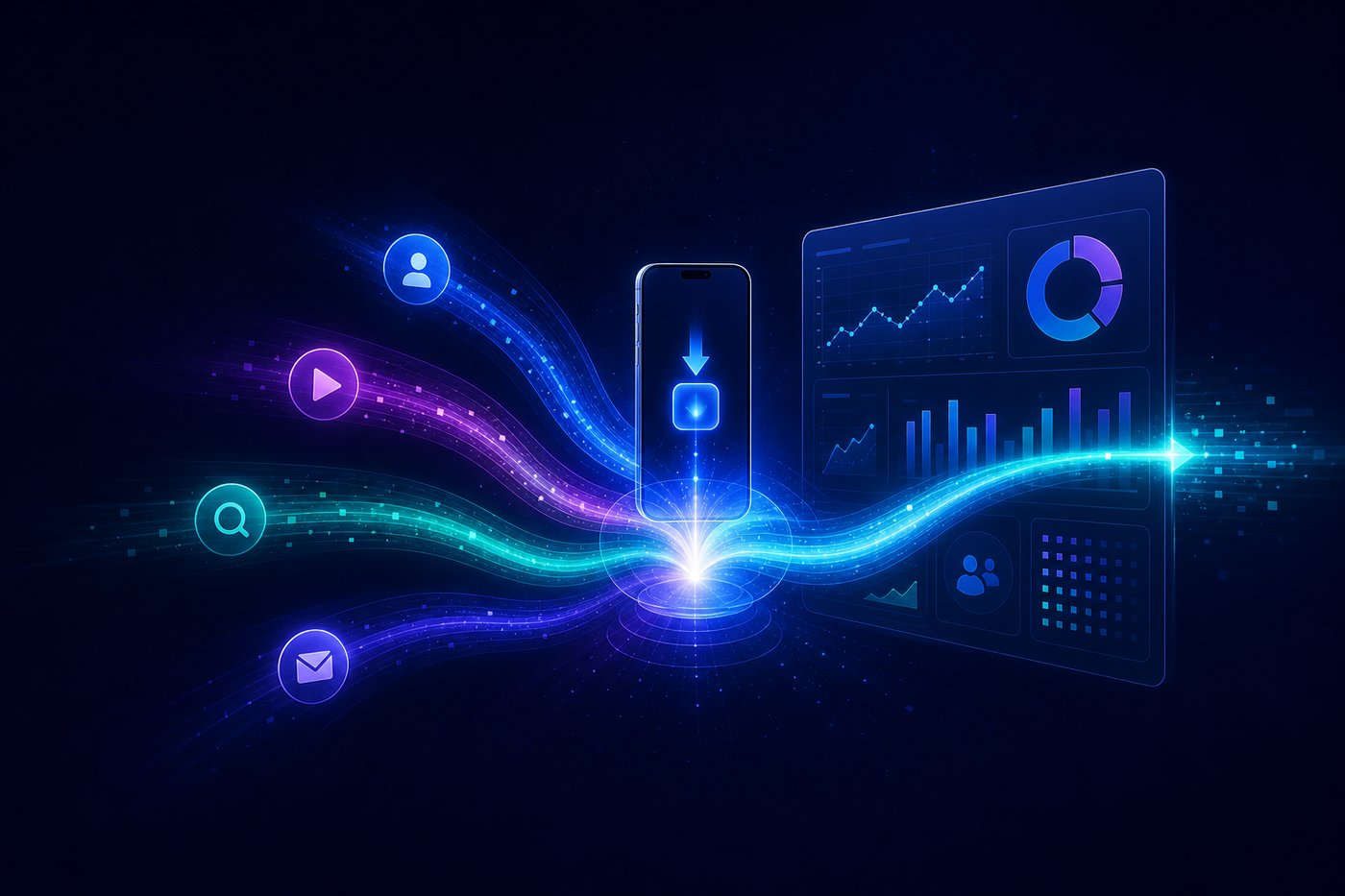
How mobile advertising attribution works: the basic flow
Every attribution system, regardless of vendor, follows the same skeleton:
Ad engagement is logged. A user taps an ad on a network (Meta, Google, TikTok, a DSP), which records a click ID, timestamp, device signals, and campaign metadata.
The install is recorded. The user installs and opens the app; your measurement SDK fires a first-open event.
A match is attempted. The attribution provider compares the install signal against the pool of recent ad engagements and decides which one to credit.
Credit is assigned and reported. The matched source flows into dashboards and back to the network's optimization engine via a postback.
The interesting part is step 3 — the match. There are two fundamentally different ways to do it.
Deterministic vs probabilistic attribution
Deterministic attribution matches on a unique, persistent identifier shared by both the ad click and the install — historically a device ID (IDFA on iOS, GAID on Android) or a click ID passed through a deep link. If the same ID appears on both sides, the match is a near-certainty: precise and auditable.
Probabilistic attribution (also called fingerprinting) is used when no shared deterministic ID is available. It estimates a match using non-unique signals — IP address, device model, OS version, timestamp proximity — and statistical modeling. It is an educated guess, not a certainty, and accuracy degrades as privacy restrictions strip away signals.
|
Dimension |
Deterministic |
Probabilistic |
|---|---|---|
|
Matching basis |
Shared unique ID (device ID / click ID) |
Statistical signals (IP, device, timing) |
|
Accuracy |
Very high |
Moderate, model-dependent |
|
Privacy exposure |
Higher (uses identifiers) |
Lower (no persistent ID) |
|
iOS post-ATT availability |
Limited without consent |
Often restricted by Apple policy |
|
Best for |
Owned channels, consented users |
Fallback when IDs are unavailable |
In practice, modern attribution blends both: deterministic where consent and identifiers allow, probabilistic (or privacy-preserving aggregate methods) as a fallback.
Mobile measurement partners (MMPs): the neutral referee
A mobile measurement partner (MMP) is an independent third party that collects attribution data across all your ad networks and acts as the single, neutral source of truth. Rather than trusting each network's self-reported numbers — where every network claims the same install — the MMP de-duplicates and assigns credit consistently. MMPs also normalize data into one schema, manage SKAdNetwork on iOS, run fraud detection, and send postbacks so network algorithms can optimize. They are the backbone of any serious mobile user-acquisition stack.
|
MMP |
Notable strengths |
|---|---|
|
Largest network integration catalog; deep dashboards; strong fraud tooling |
|
|
Clean data, automation, fraud prevention; part of AppLovin |
|
|
Deep linking and web-to-app first; strong cross-platform journeys |
|
|
Flexible, privacy-forward, configurable data controls |
|
|
Marketing analytics plus attribution; cost/ROI aggregation |
DeepClick is not an MMP and does not compete with these vendors. DeepClick sits one layer earlier — on the traffic and install-infrastructure side — making the data that flows into your MMP cleaner. More on that below.
How to set up an AppsFlyer attribution link (walkthrough)
An AppsFlyer attribution link (or "OneLink") is the tracking URL you give an ad network so installs can be credited. A practical setup:
Integrate the SDK into your iOS and Android builds and set your dev key, so the app fires first-open and in-app events.
Register the ad network as a partner in the dashboard so postbacks are configured automatically.
Generate the link with parameters like
pid(media source),c(campaign),af_adset, andaf_ad, so reporting breaks down by source, campaign, ad set, and creative.Add deep-link routing via a OneLink that sends users to the App Store, Google Play, or straight into a screen if already installed — reducing drop-off.
QA before scaling. Run a test install and confirm it is attributed to the correct
pid/cin the raw-data export.
The quality of every one of these matches depends on one thing the link cannot control: whether the traffic hitting it is real.
Multi-touch attribution: who gets the credit?
Most real journeys involve more than one touch — a user might see a video ad, later click a search ad, then install. Multi-touch attribution decides how credit is split across those touches, and a multi-touch attribution platform applies a model rather than blindly crediting the last click.
|
Model |
How credit is split |
Best when |
|---|---|---|
|
Last-click |
100% to the final touch before install |
Simple, direct-response campaigns |
|
First-click |
100% to the first touch |
Measuring top-of-funnel discovery |
|
Linear |
Evenly across all touches |
You value every interaction equally |
|
Time-decay |
More credit to touches near conversion |
Short, intent-driven cycles |
|
Data-driven |
Algorithmic, based on observed contribution |
High volume, multi-channel programs |
Last-click remains the mobile default because app-install windows are short, but data-driven models give a fairer picture when budgets are large and channels overlap.
The iOS privacy shift: ATT and SKAdNetwork
Apple's App Tracking Transparency (ATT) framework requires apps to ask permission before accessing the IDFA. Most users decline, which removed the deterministic identifier that powered classic deterministic attribution on iOS.
To fill the gap, Apple offers SKAdNetwork (SKAN) — a privacy-preserving framework where Apple itself validates installs and returns aggregated, delayed conversion data via a "conversion value." The trade-offs are real: data is aggregated (not user-level), delayed by a randomized timer, and limited in granularity. Newer versions (SKAN 4) added multiple postbacks and coarse-grained values, and Apple's AdAttributionKit extends the model further.
The practical consequence: on iOS you blend SKAN with consented deterministic data and modeled estimates, and accept more noise. This makes traffic quality and clean install flows more important than ever — when your signal is already aggregated and scarce, every bit of fraud or wasted impression corrupts a larger share of what little data you get.
Where clean traffic and install infrastructure fit in
Attribution can only ever be as accurate as the data feeding it. If a meaningful slice of your clicks are bots, click-injection, or low-intent junk, your MMP will faithfully attribute that garbage — inflating some channels, starving others, and teaching the ad algorithm to chase the wrong users. DeepClick operates on this layer: it improves the inputs to attribution rather than replacing the MMP.
Clean traffic separation. DeepClick Shield separates real, qualified visitors from bots and invalid traffic before they reach your install flow. Fewer junk sessions polluting the pool means a cleaner attribution signal and match decisions made on real humans.
Reduced install drop-off. A fast, frictionless PWA install flow keeps users from abandoning between the ad click and the first open — the exact gap where attribution is lost and installs go uncredited.
Re-engagement recovery. Re-engagement brings back users who dropped off, recovering installs and conversions that would otherwise leak out of your funnel unmeasured.
None of this makes DeepClick an attribution vendor — your MMP still does the attributing. DeepClick simply ensures the traffic and installs it measures are real and complete.
Mobile advertising attribution best practices
Use an MMP as your neutral source of truth — never rely on each network's self-attributed numbers, which double-count.
Pick an attribution model on purpose. Default to last-click for direct response; move to data-driven when channels overlap at scale.
Plan for iOS separately. Treat SKAN data as aggregated and delayed; do not expect user-level parity with Android.
Validate every attribution link before scaling with a QA install that confirms the source is credited correctly in raw data.
Protect the top of the funnel. Filter bots and invalid traffic so attribution is computed on real users, not noise.
Frequently asked questions
What is the difference between mobile attribution and mobile measurement?
Attribution assigns credit for an install or event to a specific source. Measurement is the broader practice of tracking all the metrics around it — installs, retention, ROI, lifetime value. Attribution is one core function inside measurement, and an MMP delivers both.
Is AppsFlyer an attribution tool or an MMP?
Both. AppsFlyer is a mobile measurement partner whose core function is attribution; it also handles deep linking, fraud protection, audiences, and analytics. For a comparison against Adjust, Branch, Kochava, and others, see our best attribution software guide.
Did iOS 14.5 kill mobile attribution?
No, but it changed it. App Tracking Transparency made the IDFA largely unavailable, so deterministic attribution on iOS now depends on consent, while SKAdNetwork provides aggregated data. Attribution still works — it is just noisier on iOS.
What is a mobile app attribution link?
It is a tracking URL given to an ad network that carries campaign parameters and, on click, routes the user to the store or app while recording the engagement so the resulting install can be credited to the right source.
Can clean traffic really improve attribution accuracy?
Yes. Attribution is only as reliable as its inputs. Removing bots, click-injection, and invalid traffic before the install means the matched data reflects real humans — especially valuable on iOS where signal is already scarce.
Key takeaways
Mobile advertising attribution connects installs and in-app events back to the ad, campaign, and creative that caused them.
Matching is deterministic (shared ID, high accuracy) or probabilistic (statistical estimate, used as fallback); modern stacks blend both.
An MMP (AppsFlyer, Adjust, Branch, Kochava, Singular) is the neutral referee that de-duplicates attribution across networks.
Multi-touch models decide how credit is split; last-click is the mobile default, data-driven is fairer at scale.
iOS ATT and SKAdNetwork replaced deterministic IDFA matching with aggregated data — raising the value of clean signal.
DeepClick is the traffic-quality and install-infrastructure layer that makes attribution data cleaner; it does not replace your MMP.
