Paid Social Media Advertising: The Complete 2026 Guide

Paid social media advertising in 2026 is unrecognizable from 2020. Meta's Advantage+ does in 24 hours what used to take a media buyer two weeks. TikTok ads outperform Meta on awareness for 60% of consumer brands we audit. iOS privacy changes broke deterministic attribution, and most marketing teams haven't fully adapted. Creative is the new bottleneck — not budget, not targeting.
This is the complete guide to paid social media advertising for 2026 — covering what it is, how it differs from organic, 15+ social media campaign examples that worked, platform-by-platform breakdowns, the strategy frameworks that scale, the tools that matter, and when (and when not) to hire an agency.
It's a long read. Use the table of contents to jump.
1. What is paid social media advertising?
Paid social media advertising is the practice of paying social platforms (Meta, TikTok, LinkedIn, X, Pinterest, YouTube, Snapchat, Reddit) to distribute branded content to targeted audiences. Unlike organic posts, which rely on followers and platform algorithms to reach users, paid ads guarantee distribution to the audience criteria you define and bid for.
In 2026, the global paid social market is projected to exceed $300B in spend, with Meta and TikTok capturing the majority. The category includes everything from $50/day local-business boosts to $50M/quarter performance programs at Fortune 500s.
Three things that define modern paid social
Privacy-driven attribution shift — Server-side conversions (CAPI, CAPI for TikTok, LinkedIn Conversions API) replace cookie-based pixel reporting
AI-driven optimization — Advantage+, ASC, TikTok Smart Performance Campaigns automate audience and placement decisions
Creative as the lever — With AI handling targeting, creative variation is the highest-leverage activity
2. Paid vs organic social: when to use which
| | Paid social | Organic social | |---|-------------|---------------| | Reach | Predictable, paid | Unpredictable, free | | Speed | Same-day | Compounds over months/years | | Audience | Defined, targeted | Existing followers | | Cost per impression | Variable, $5–$30 CPM typical | Time-cost only | | Best for | Demand creation, scale | Brand building, community |
The right answer is almost never "one or the other." The best programs use organic to build trust and pattern-match what resonates, then use paid to amplify what's working to net-new audiences.
3. 15+ social media campaign examples that worked
Real campaigns we've studied or run, organized by what made them work:
Awareness / brand-led campaigns
1. Liquid Death — "Greatest Hates" Reading
What worked: Turned 1-star Amazon reviews into a celebrity-read video ad. Drove 30M+ views on TikTok and Meta.
Lesson: User-generated negative feedback can be the funniest, most shareable creative.
2. Cluely — "Cheat on Everything"
What worked: Single TikTok video ($0 paid initially, then amplified) drove $5M ARR for an AI startup in 90 days.
Lesson: One viral organic moment + paid amplification beats months of paid-only spend.
3. Duolingo — Owl's Death
What worked: Killed off the mascot, then resurrected it. Coordinated TikTok + Meta campaigns turned a brand bit into 100M+ impressions.
Lesson: Coordinated multi-platform storytelling outperforms parallel single-platform campaigns.
Performance / direct-response campaigns
4. Athletic Greens (AG1) — UGC Testimonial Engine
What worked: 200+ creator-shot UGC videos reused across Meta and TikTok at scale. ROAS held above 3× through 2024 by constant creative refresh.
Lesson: Creative refresh cadence is the moat at scale.
5. ConvertKit (now Kit) — "Creator Stories"
What worked: Long-form Meta video ads featuring real customers' creator businesses. Lower CPM, higher LTV.
Lesson: B2B SaaS can win on Meta when creative is documentary, not promotional.
6. Notion — Templates as Top-of-Funnel
What worked: Promoted Notion templates as "free downloads" via Meta lead ads, then nurtured to product trial.
Lesson: Free utility beats free trial as a top-of-funnel offer.
Retargeting / mid-funnel campaigns
7. Glossier — "You Looked"
What worked: Highly personalized Meta retargeting based on which product page a user viewed.
Lesson: Retargeting CTR can be 5–10× cold traffic when the ad references the specific product.
8. Allbirds — Carbon Footprint Calculator Retargeting
What worked: Cart abandoners saw an ad showing "this purchase = X lbs CO₂ saved."
Lesson: Tying retargeting to brand values converts hesitant cart abandoners.
B2B / LinkedIn campaigns
9. Gong — "How Top Reps Sell"
What worked: LinkedIn sponsored content with founder-shot videos giving away tactical sales advice. Built a $3B ARR pipeline at scale.
Lesson: Give value in the ad itself; the meeting request comes after trust.
10. HubSpot Academy — Free Certifications
What worked: Sponsored LinkedIn ads for free certifications. Massive top-of-funnel volume.
Lesson: Educational offers outperform demo offers on LinkedIn.
TikTok-native campaigns
11. Ridge Wallet — Founder POV
What worked: Founder Sean Frank showing up directly in TikTok ads talking like a creator, not an executive.
Lesson: Founder-led TikTok ads convert better than polished brand spots.
12. Scrub Daddy — Pop-culture Memes
What worked: Reactive ads built on whatever pop-culture moment was trending that week.
Lesson: TikTok rewards speed of cultural participation over production polish.
App install campaigns
13. Duolingo — TikTok App Install
What worked: Mascot-led ads optimized for app installs. CPI under $1 in many markets.
Lesson: Owned mascot IP can carry app-install economics that paid creators can't.
14. Cash App — Twitter (X) Giveaways
What worked: Promoted "Cash App Friday" giveaways drove app installs at scale.
Lesson: Predictable mechanic + Twitter's real-time culture = compounding installs.
Community / Reddit campaigns
15. Notion — Reddit Subreddit Sponsorship
What worked: Sponsored Notion posts inside niche productivity subreddits with genuinely useful templates.
Lesson: Reddit punishes promotional ads; rewards utility-first sponsored posts.
Bonus: AI-creative campaigns
16. Klarna — AI-Generated Variant Testing
What worked: Used AI image tools to ship 200+ creative variants per week, scaling the variant pool 10×.
Lesson: AI doesn't replace creative direction — it scales the variants you can test.
4. The major platforms in 2026
Meta (Facebook + Instagram)
Strengths: Broadest audience, strongest signal, most mature optimization (Advantage+)
Weaknesses: Creative fatigue is brutal at scale; iOS attribution gaps
Best for: B2C, e-commerce, app installs, retargeting
Typical CPMs: $8–$25
2026 watch: Advantage+ Shopping Campaigns now default; manual ad sets less effective
TikTok
Strengths: Discovery-driven algorithm rewards new accounts; younger audiences
Weaknesses: Geopolitical regulatory uncertainty; attribution is messier than Meta
Best for: B2C, especially under-35; viral discovery; UGC-heavy creative
Typical CPMs: $4–$15
2026 watch: Smart Performance Campaign (SPC) is the new default
Strengths: Job-title and company-size targeting; B2B intent
Weaknesses: Highest CPMs in social ($30–$80); creative options narrower
Best for: B2B SaaS, recruiting, executive thought leadership
Typical CPMs: $30–$80
2026 watch: Lead gen forms still convert best; document ads still under-used
X (formerly Twitter)
Strengths: Real-time, journalist reach, B2B thought leadership
Weaknesses: Brand safety inconsistent; smaller paid product
Best for: B2B awareness, product launches, news-cycle moments
Typical CPMs: $6–$20
See full the Twitter (X) marketing tools roundup for managing X paid + organic
YouTube (Shorts + Long-form)
Strengths: Highest-attention format; demographic targeting via Google
Weaknesses: Production cost; longer optimization cycles
Best for: Consideration-stage B2C and B2B
Typical CPMs: $5–$30
Pinterest, Snapchat, Reddit
Pinterest: Best for home, fashion, food verticals targeting decision-stage women
Snapchat: Best for under-25 awareness in select verticals (gaming, beauty)
Reddit: Best for niche B2B and developer-tool audiences; lowest CPMs in social
5. How to build your paid social strategy
The 5-step framework — define audience, pick platforms, set budget, build creative, measure — is too important to compress here. We've broken it out into a full playbook including a 30-60-90 day rollout:
→ Read the full strategy playbook: the paid social strategy playbook
6. Best tools for managing paid social campaigns
The tooling stack falls into three layers:
Publishing & scheduling — Buffer, Hootsuite, Sprout Social, Later
Listening & monitoring — Sprout Social, Brandwatch, Mention, Brand24, Talkwalker
Cross-channel attribution & campaign tracking — DeepClick, server-side trackers, custom UTM platforms
For the 12-tool deep dive across these layers, see the social media monitoring tool roundup. For X-specific tools, see the Twitter (X) marketing tools roundup.
7. When to hire a paid social agency
Generally, in-house works below $20K/month spend and an agency starts to make sense above $50K/month — but the answer depends more on creative throughput than on spend size. Full evaluation framework, pricing models, and 12 questions to ask a candidate agency:
→ Full agency guide: the paid social agency guide
8. Measuring success in 2026
The single biggest mindset shift: stop trusting platform-reported ROAS as ground truth. With probabilistic attribution and lift-driven measurement now the standard, the modern measurement stack looks like this:
Platform attribution — what Meta / TikTok / LinkedIn report (directional)
Server-side tracking — first-party CAPI/Conversions API (more accurate)
Independent tracker — UTM-based, like DeepClick's return-flow links, for cross-platform reporting
Incrementality testing — geo holdouts, conversion lift studies (ground truth)
A campaign that shows 5× ROAS on Meta but flat in your incrementality test is not working — it's stealing credit from organic conversions.
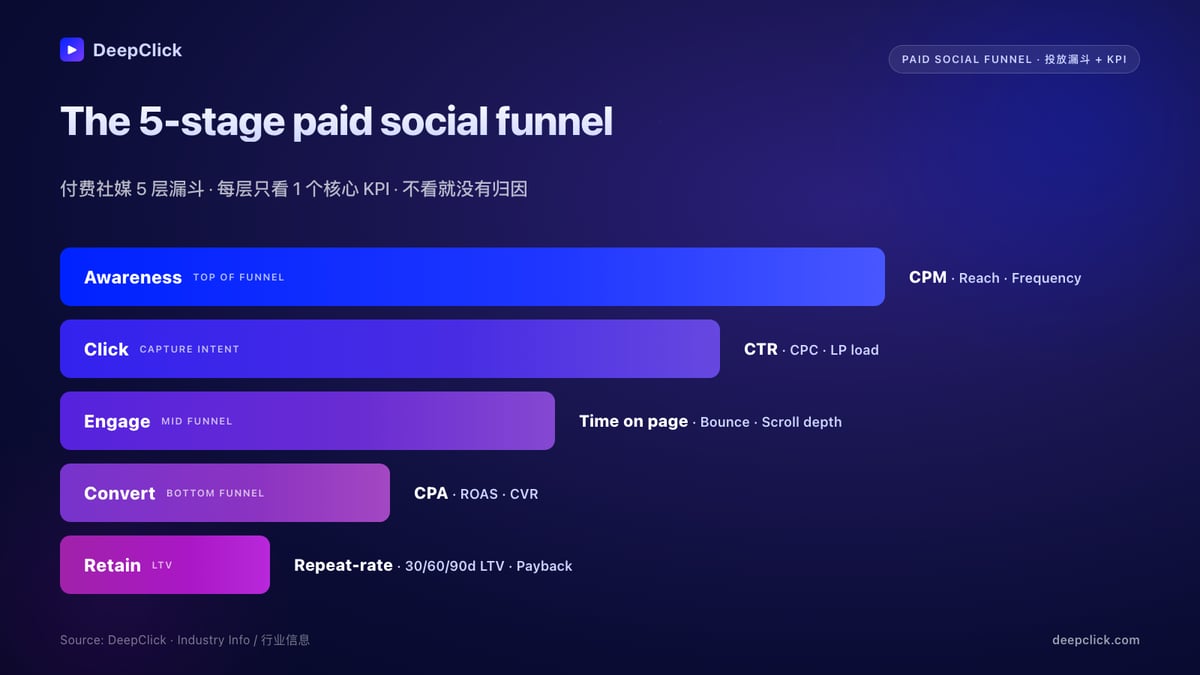
Core paid social metrics by funnel stage
| Stage | Metrics | |-------|---------| | Awareness | CPM, reach, frequency, video view rate | | Consideration | CTR, CPC, landing page view, dwell time | | Conversion | CPA, ROAS, conversion rate | | Retention | Repeat purchase rate, LTV, payback period |
9. FAQ
What's a good ROAS for paid social media advertising?
Depends on category. E-commerce: 2–4× is sustainable, 4×+ is strong. SaaS: think LTV:CAC ratio (3:1 healthy). Agencies/services: 5×+ since margins are higher.
Which platform should I start with?
For B2C, Meta or TikTok depending on audience age. For B2B SaaS, LinkedIn paired with Meta retargeting. For local services, Meta. Don't start with three platforms at once.
How much should I budget per month?
Minimum 30× target CPA per platform. For a $30 target CPA on two platforms, $1,800/mo before creative production.
Is paid social still worth it in 2026 with rising CPMs?
Yes, but the bar is higher. Brands with weak creative, no attribution stack, or under-funded testing get worse results every year. Brands with strong creative systems and proper measurement still find 3–5× ROAS profitable.
Do I need an agency?
Below $20K/month, usually no — one strong in-house generalist wins. Above $50K/month, the agency case strengthens (creative throughput, specialist talent). See the paid social agency guide.
How long until I see results?
First signal in 30 days; statistically meaningful results in 60–90; sustained profitability typically months 4–6.
