
How to Build a Paid Social Strategy from Scratch (2026)

Most "paid social strategies" you see online are dressed-up channel checklists: run Meta ads, then TikTok, then LinkedIn. That's not a strategy. That's a media plan with a strategy-shaped hat on.
A real paid social strategy answers four questions before you spend a dollar: Who exactly are we trying to reach? On which platforms do they actually spend time? What outcome would make this profitable? And how will we know if it's working?
This guide is the playbook we use to set up new paid social programs from scratch in 2026 — five steps, eight common traps to avoid, and a 30-60-90 day rollout you can copy.
What is a paid social strategy?
A paid social strategy is the documented plan that connects a specific business goal (revenue, leads, app installs, brand lift) to the audience, platforms, budget, creative, and measurement system that will deliver it. It exists before campaigns are built, and it's what every campaign decision should trace back to.
Without one, paid social becomes random testing. With one, every test is a hypothesis with a known cost of being wrong.
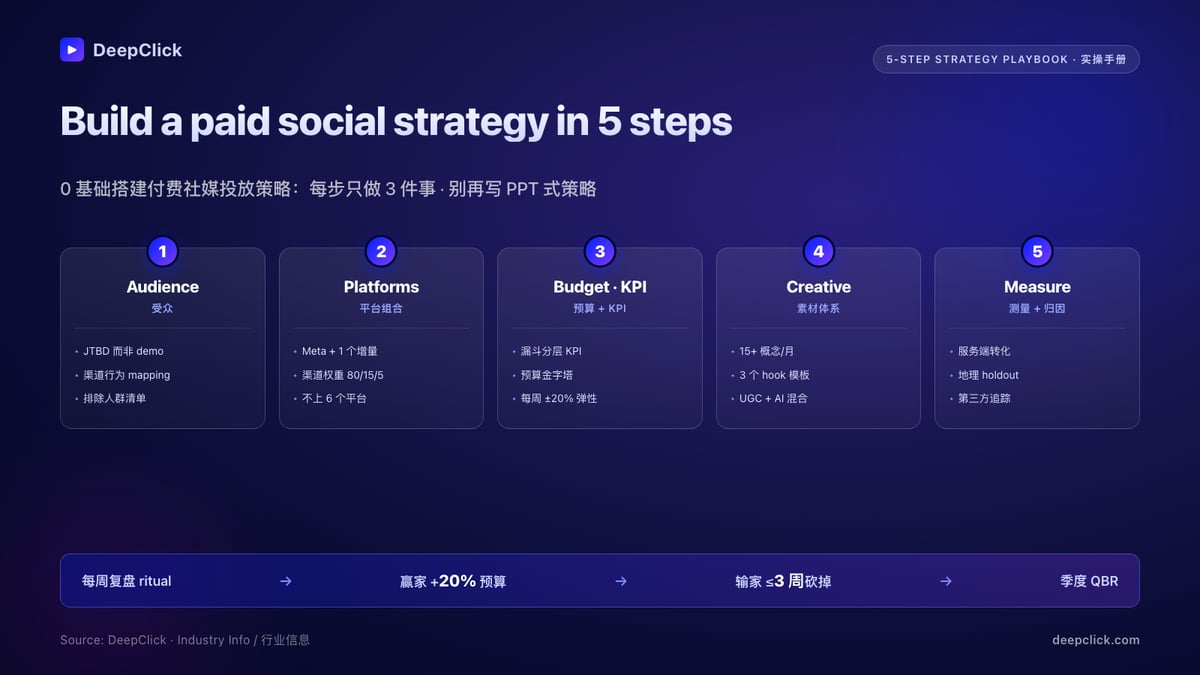
Step 1: Define your audience (not "demographics")
The single biggest mistake we see is teams skipping straight to "we'll target 25–45 year olds in tier-1 cities." That's not an audience — that's a search filter.
Instead, build 3 to 5 audience segments with this template:
|
Field |
Example |
|---|---|
|
Segment name |
"Burnt-out enterprise SaaS PMs" |
|
What they're trying to do |
Hit Q4 OKRs without rebuilding the roadmap |
|
Where they hang out |
LinkedIn, Reddit r/ProductManagement, Lenny's Newsletter |
|
What pain they pay to solve |
Stakeholder alignment, not feature prioritization |
|
Trigger event |
New VP joins, board pushes for a pivot, missed quarter |
|
Objection |
"We already use Aha! / Productboard" |
Each segment becomes a separate ad set / ad group with its own creative — never one mushy campaign trying to talk to all of them at once.
Step 2: Pick the right platform mix
Not every channel is right for every goal. Match platform to objective:
|
Goal |
Best primary platform |
Why |
|---|---|---|
|
B2C impulse purchase |
Meta (Facebook + Instagram) |
Best signal + lookalike modeling |
|
Short-form viral discovery |
TikTok |
Algorithm rewards new accounts |
|
B2B lead gen / SaaS |
LinkedIn + Meta retargeting |
Job-title targeting + warm-audience close |
|
App install (gaming) |
Meta + TikTok + Google App |
Multi-platform diversification reduces risk |
|
Local services |
Meta + YouTube Shorts |
Geo-targeting + video storytelling |
|
Thought leadership |
LinkedIn + X (Twitter) |
B2B audience, journalist reach |
For most brands, the right answer in 2026 is 2–3 platforms, not 5+. Spreading $20K across 5 platforms is the fastest way to learn nothing on any of them.
Need help comparing platforms? See our complete the complete paid social advertising guide for platform-by-platform deep dives.
Step 3: Set a realistic budget and KPIs
A frequent founder question: "How much should I spend on paid social to start?"
Rule of thumb: Your minimum monthly test budget per platform = 30 × your target CPA. If you want $30 leads, you need at least $900/month/platform to gather statistically meaningful data within 4 weeks.
Below that floor, you're not testing — you're guessing.
Pick KPIs by funnel stage
Top of funnel: CPM, CTR, video view rate, frequency
Mid funnel: CPC, landing page view rate, add-to-cart rate
Bottom of funnel: CPA, ROAS, conversion rate
Post-purchase: LTV:CAC ratio, payback period
Common error: optimizing top-of-funnel campaigns on bottom-of-funnel KPIs. You can't expect a cold-audience reach campaign to deliver 5× ROAS in week one.
Step 4: Build a creative system, not one-off ads
Modern paid social is creative-bottlenecked, not budget-bottlenecked. Meta's own data shows the average ad fatigues in 7–14 days at scale. That means a $100K/month account needs 15–30 new creative concepts per month.
Build a creative system instead:
Hooks library — 20+ hook variations (question, stat, contrarian, story, demo)
Format matrix — static image, UGC video, founder talking head, screen recording, carousel
Concept buckets — pain-driven, social-proof, comparison, demo, behind-the-scenes
Iteration cadence — every Monday, ship 5 new variants based on last week's winners
Match creative to platform native style:
TikTok: lo-fi UGC, 9:16, captions burnt in
Meta Reels: UGC + clear hook in first 1 second
LinkedIn: founder POV, personal story angle
X: screenshot of a tweet, controversial take
Step 5: Measure, attribute, and iterate
iOS 14.5 broke deterministic attribution; the world is now probabilistic. Three things you must set up in 2026:
Server-side conversion API (CAPI) for Meta, Conversions API for TikTok, LinkedIn Insight Tag
UTM hygiene — every ad uses a structured UTM scheme so cross-platform reporting actually works
Independent measurement layer — don't trust just platform-reported attribution. Use a tracking platform that gives you cross-channel views, like server-side trackers or campaign URL platforms (see the social media monitoring tool roundup for a 12-tool comparison).
The weekly review ritual
Every Monday, ask:
Which ads / ad sets crossed our CPA threshold? (scale them)
Which are above CPA but trending down? (give them 7 more days)
Which are 2× CPA after $200 spend? (pause them)
What's our creative win rate (winners / tested)? (target 20%+)
8 common paid social strategy mistakes
Targeting too narrow on Meta — Advantage+ + broad targeting often beats hand-picked interests in 2026
Confusing reach and frequency goals — A reach campaign should not optimize for purchases
No baseline organic before turning on paid — You'll never know if paid is working
Ignoring creative refresh cadence — Same ad for 30+ days = guaranteed CPA inflation
Optimizing too soon — Wait for 50+ conversions per ad set before judging
Treating LinkedIn like Meta — Different bidding, different creative, different patience required
Skipping incrementality testing — Platform ROAS lies; geo holdout tests are your friend
Not budgeting for creative production — Plan 15–25% of media spend for creative
A 30-60-90 day rollout for a new paid social program
Days 1–30: Foundation
Audience segments documented
Platform pixels + CAPI installed and tested
Creative system shipped with 15 starter concepts
Test budget: 30× target CPA per platform
Days 31–60: Learn
Run broad-audience tests across 2 platforms
Identify 2–3 winning creative concepts
Pause anything 2× over CPA after $200 spend
Begin creative refresh cadence (5 new variants/week)
Days 61–90: Scale
Increase spend on winners by 20% per week (max)
Layer retargeting + lookalike audiences
Add a third platform if Day-30 tests showed signal
Begin incrementality testing on geo holdouts
How does this fit into a complete paid social program?
A strategy is the foundation; tools and team are the execution layer. For the broader landscape, see our the complete paid social advertising guide. If you're considering outsourcing execution, our the paid social agency guide walks through how to evaluate agencies.
FAQ
How much should I budget for my first month of paid social?
Plan 30× your target CPA per platform per month, minimum. For a target $30 CPA on two platforms, that's $1,800/month before creative production costs.
How long until paid social is profitable?
Plan 90 days minimum to find a winning creative + audience combination. Most brands hit positive ROAS in months 4–6 at scale, not week 1.
Should I run paid social and SEO at the same time?
Yes — they answer different audience needs. Paid social creates demand; SEO captures it. The two compound.
Do I need an agency or can I do this in-house?
Below $20K/month spend, in-house with one strong generalist usually wins. Above $50K/month, an agency or specialist team typically delivers better creative throughput. See our the paid social agency guide for evaluation criteria.
