Ad Creative Production Tips: From Brief to Launch for Meta, TikTok and Google

Most performance marketing teams can copy a bidding strategy or an account structure. What they struggle to make repeatable is creative output and creative quality. This guide breaks ad creative production into a reusable workflow for Meta, TikTok and Google: brief, format, production method, platform specs and safe zones, copy and the first 3 seconds, batch variations and naming, then testing and refreshing. Where a sub-topic already has a dedicated guide, we summarize the essentials and link to it.
Ad creative production tips at a glance
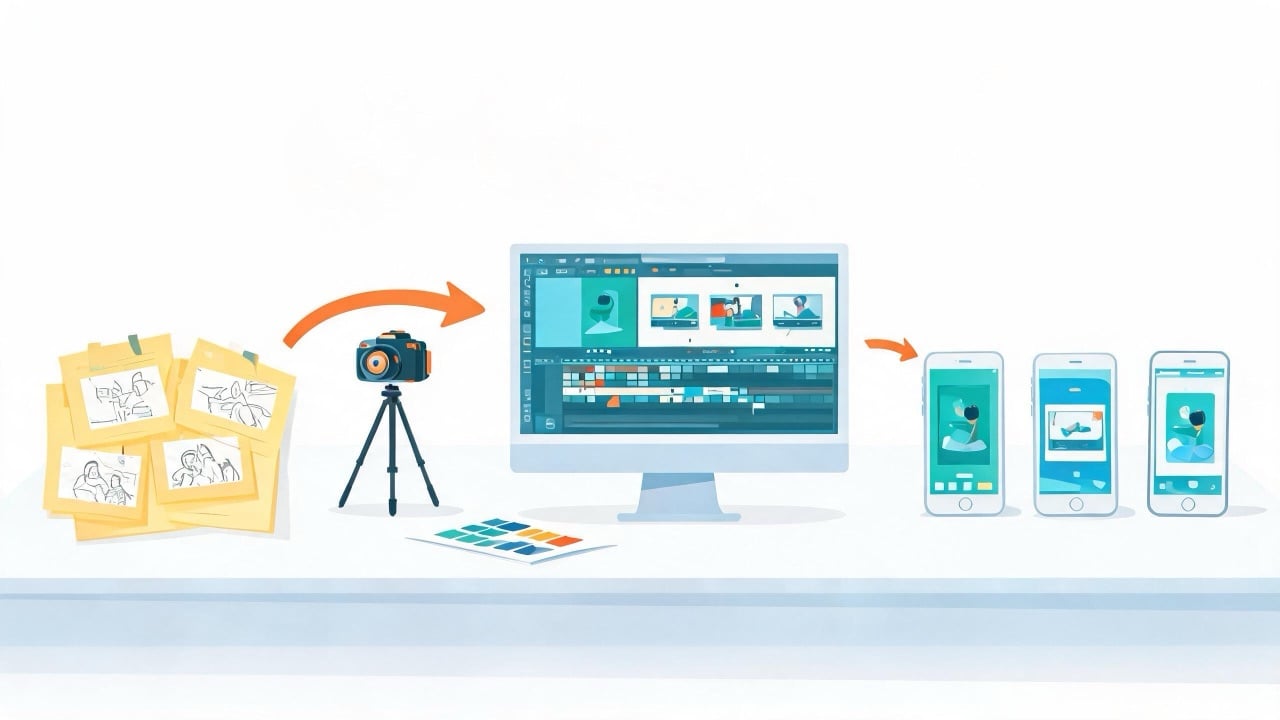
If you remember one thing: ad creative production is a pipeline, not a one-off burst of inspiration. Here is the skeleton of that pipeline:
- Write the brief: who it is for, what problem it solves, why they should believe you, and what you want them to do.
- Choose the format: vertical video, square static, carousel or a mix, based on platform and objective.
- Pick the production method: live-action shoot, UGC, remix editing, AI generation or static design.
- Match platform specs and safe zones: dimensions, length, file type, caption and CTA placement.
- Sharpen copy and the first 3 seconds: this decides whether people stop scrolling.
- Build batch variations with a naming convention: so results are readable and reusable.
- Launch, test, watch for fatigue and refresh: feed every round of data back into the next brief.
Step 1: Write a creative brief that can actually be produced
Many ads "look fine but don't scale" because the brief was vague. A workable brief covers at least:
|
Section |
What to spell out |
Common mistake |
|---|---|---|
|
Audience |
Region, language, usage context, core pain point |
Only demographic labels like "18-35" |
|
Core message |
One main benefit plus one or two supporting points |
Cramming every feature into one ad |
|
Proof |
Demo, comparison, user feedback, real screenshots |
Piling up empty adjectives |
|
Call to action |
One of install, sign up, inquire or buy |
Several CTAs competing |
|
Angle hypothesis |
The creative angle this batch is meant to validate |
No hypothesis, so nothing is learned |
|
Compliance limits |
Platform policy, local rules, wording to avoid |
Finding out only after a rejection |
Tip: give each brief exactly one angle hypothesis, such as "pain point first" vs "product demo" vs "compare alternatives". Producing different angles separately is what makes later tests attributable.
Step 2: Choose formats by platform and objective
Format drives production cost and which placements you can run on:
- Vertical video (9:16): the default for TikTok, Reels and Shorts; good for demos, talking-head and story formats.
- Square or 4:5 video and images: broad compatibility across Meta feeds, so one asset covers many placements.
- Horizontal (16:9): YouTube in-stream and some Google placements; suits fuller product walkthroughs.
- Static images and carousels: fast to make and iterate; good for pricing, feature comparisons and list-style messages.
Video and static are not either-or. See static vs video ads performance for where each wins, and video ad length best practices for how long your cuts should run.
Step 3: Pick the right ad creative production method
The same message can be expressed through very different production methods:
|
Method |
Best for |
Cost and speed |
Main risk |
|---|---|---|---|
|
Live-action shoot |
Physical products, premium brand assets |
Higher; needs crew and location |
Too slow to keep pace with testing |
|
UGC (creator or real-user view) |
Conversion ads that need authenticity |
Medium; depends on creator access |
Uneven quality; usage rights and compliance |
|
Remix editing (from an asset library) |
Many variations fast, angle tests |
Low and quick |
Look-alike ads that fatigue quickly |
|
AI generation (image, video, voiceover) |
Concept visuals, backgrounds, multi-language voice, variations |
Low to medium, fast |
Visual artifacts; platform AI-disclosure rules |
|
Static design |
Direct benefit statements, carousels |
Lowest and fastest |
Information overload, too much on-image text |
Practical advice:
- Validate fast first: test a new angle cheaply with a remix or static version, then invest in a shoot or UGC once it shows signal.
- UGC is about the script, not the camera: authenticity comes from natural speech and real usage moments. See UGC ads for performance marketing.
- Use AI to scale, not to decide: AI is great for turning a proven angle into more visuals and languages; choosing the angle is still a human call.
- Build an asset library: tag B-roll, product close-ups and voiceover clips from every shoot so remix editing gets faster each round.
Step 4: Platform specs and safe zones
Wrong specs mean cropping, compression or covered elements, which wastes all the earlier work. Align three things before you edit:
- Dimensions and ratio: master vertical in high-resolution 9:16, then export 1:1, 4:5 and 16:9 cut-downs. Do not upscale the other way round.
- Safe zones: short-video interfaces overlay the edges with the account name, caption area, right-side action buttons and bottom CTA. Keep key text, product and faces in the central area and keep captions off the very bottom.
- Sound and captions: many people browse feeds muted, so video should make sense without sound. Burn in captions or use platform auto-captions.
For TikTok specs, safe zone guidance and native style tips, see TikTok ads creative best practices.
Step 5: Ad copy and the first 3 seconds
Whether an ad gets watched depends heavily on the opening. Common hook types:
- Pain-point question: name the problem your audience is living with.
- Result first: show the after state, then explain how.
- Counter-intuitive claim: say something that challenges expectations to spark curiosity.
- Point-of-view scene: use a first-person shot to drop the viewer into a specific situation.
Hook breakdowns live in ad hooks: the first 3 seconds; frameworks for primary text, headlines and CTAs are in ad copywriting for performance ads. Do not skip the cover frame either; on some placements it is the first thing people see. See thumbnail optimization for ads.
Step 6: Batch variations and a naming convention
Any single ad has a large element of luck. Producing variations systematically is how you find patterns that hold.
How to split variations: change one variable at a time and keep everything else fixed.
- Hook variations: same body, three to five different openings.
- Message variations: same hook, a different main benefit.
- Format variations: same script as talking-head, caption-only and remix versions.
- Size variations: export the same ad in several ratios to cover placements.
How to name them: a name should tell anyone what the ad is testing. Join fixed fields in a fixed order:
date_product_angle_method_hook-id_ratio_version, for example "1014_AppA_PainPoint_UGC_H2_916_v1".
Once the team shares one convention, reports can be split by field directly instead of opening every ad to remember what it was. For how many ads to put in each ad set, see how many creatives per ad set.
Step 7: Launch, test and refresh before fatigue
Production does not stop at launch; it moves into a test, judge and refresh loop:
- Test with structure: group tests by angle or variable, and set decision metrics and minimum data before calling a winner. See how to test ad creatives.
- Watch fatigue signals: rising frequency, falling click-through rate and climbing cost per result usually mean an ad is wearing out. See ad creative fatigue signs.
- Refresh on a rhythm: do not wait until your top ads collapse. Keep a steady production line so new angles enter the test pool early.
- Feed results back into the brief: write the winning angle, hook and format into the next brief so every round builds on the last.
Common mistakes in ad creative production
- Chasing polish only: a beautiful ad is not the same as a converting ad; in feeds, ads that feel like content often look more natural.
- One ad, every benefit: the more you say, the less anyone remembers.
- Shooting without a hypothesis: you cannot explain the result, so you cannot reuse the lesson.
- Ignoring the landing page handoff: if the landing page does not match what the ad promised, conversion suffers. Check that the first screen echoes the ad while you are still producing it.
FAQ
What is the most important part of ad creative production?
The brief and its angle hypothesis. Production methods and editing skills can always improve, but if the question an ad is meant to answer is unclear, even excellent production rarely yields a reusable lesson.
Which production method should a new team start with?
Start with remix editing and static designs. They are cheap and fast, which suits validating creative angles. Once an angle shows a stable signal, invest in a live-action or UGC version.
Can AI-generated ad creatives be used as-is?
They can be part of your creative mix, but review them for visual artifacts, text errors and factual accuracy, and follow each platform's AI-content disclosure rules. The safer use is expanding variations of angles you have already validated.
Does one set of creatives need to work on every platform?
You can share scripts and angles, but avoid running the exact same file everywhere. Export and adjust for each platform's ratio, length, safe zones and native style.
How often should ad creatives be refreshed?
There is no fixed cycle; it depends on budget, audience size and fatigue signals. A more practical approach is to keep watching frequency, click-through rate and cost per result, and always have new ads waiting in the test pool.
Conclusion
Strong ad creative production is less about any single trick and more about a repeatable process: a clear brief, platform-fit formats, a production method that suits the stage, correct specs, a sharp opening, attributable variations and continuous testing and refresh. Get that pipeline running and both output and quality can improve together.
Once creatives bring people in, the landing page and link experience also shape the outcome. DeepClick offers tools for ad landing pages and link management that support media buying teams beyond the creative itself.
