Facebook Ads Account Structure (2026): How Many Campaigns, Ad Sets, and Accounts You Actually Need

Facebook Ads Account Structure (2026): How Many Campaigns, Ad Sets, and Accounts You Actually Need
Ask ten media buyers about Facebook ads account structure and you will get ten diagrams. Most of the disagreement is downstream of one question that rarely gets asked out loud: what is the structure for?
Structure does two jobs. It controls how Meta's delivery system pools your conversion data, and it controls whether you can tell what happened when results move. Those two jobs pull in opposite directions — the delivery system wants fewer, bigger buckets; diagnosis wants more, smaller ones. Every structure decision below is a trade between them.
The three levels, and what each one actually controls
|
Level |
You set |
It controls |
|---|---|---|
|
Campaign |
Objective, budget strategy |
What Meta optimises toward; where budget can flow |
|
Ad set |
Audience, placement, budget, schedule |
Who sees it, and where learning happens |
|
Ad |
Creative, copy, destination |
What they see |
The critical one is the ad set. That is the unit Meta's learning phase operates on, and it is the level where fragmentation does its damage.
Consolidation vs fragmentation: the learning-phase math
Meta's delivery system needs roughly 50 optimisation events per ad set per week to exit the learning phase and deliver stably. That number is the single most useful constraint in structure design, because it converts a vague preference into arithmetic.
Work it backwards from your own numbers:
- 200 conversions per week, 4 ad sets → 50 each. Every ad set can stabilise.
- 200 conversions per week, 12 ad sets → about 17 each. None of them stabilise. All twelve stay in learning, costs stay high, and results stay noisy.
The same budget, split differently, produces completely different delivery behaviour. This is why "we tested more audiences and performance got worse" is such a common and such a misread result: the test structure, not the audiences, caused the drop.
The rule that falls out of this: never create an ad set you cannot feed to roughly 50 weekly events. If the maths does not work, you do not have an audience-testing problem — you have a budget-concentration problem.
How many campaigns should a Facebook ads account have?
Fewer than you think. A workable default for most advertisers:
- One campaign per objective per market. Purchases in the US is one campaign. Leads in the US is another. Purchases in Germany is another.
- Do not split campaigns by creative theme. That is what ads are for.
- Do not split campaigns to "give budget" to something. That is what budget strategy is for.
Every extra campaign is another place your budget can be stranded and another row to read when you are trying to work out what changed.
How many ad accounts do you actually need?
This is a different question from campaigns, and the answer is driven by risk and billing rather than delivery:
Open a separate ad account when:
- You bill a genuinely separate legal entity or client
- You run a market whose payment method or currency differs
- You need a hard permission boundary between teams
Do not open a separate ad account:
- To "test" a new vertical you already have data for
- To restart after poor performance — you are throwing away account history that helps you
- To spread risk across duplicated assets, which is a pattern platforms specifically look for
Ad accounts do not inherit each other's learning. Splitting one healthy account into three fragments your data three ways and buys you nothing that campaign structure could not have delivered. Before you buy or rent additional accounts to sidestep a restriction, read our breakdown of what that market actually costs: buying Facebook ads accounts — risks, pricing, survival.
All of these accounts should sit inside one business — see how to create a Facebook Business Manager for the ownership layer above them.
Naming conventions that make diagnosis possible
A naming convention is not administrative tidiness; it is what lets you filter and pivot six months later. Keep it mechanical and positional:
[Market]_[Objective]_[Audience]_[Date]
US_PUR_Broad_2026-08
US_PUR_LAL1-Purchasers_2026-08
Three rules that matter more than the exact format:
- Never rename a live ad set. You break your own historical comparisons.
- Put the date in. You will need to know which cohort a structure belongs to.
- Encode the variable you are testing, so the report tells you the answer without opening each ad set.
A default structure that works for most advertisers
Start here and deviate only with a reason:
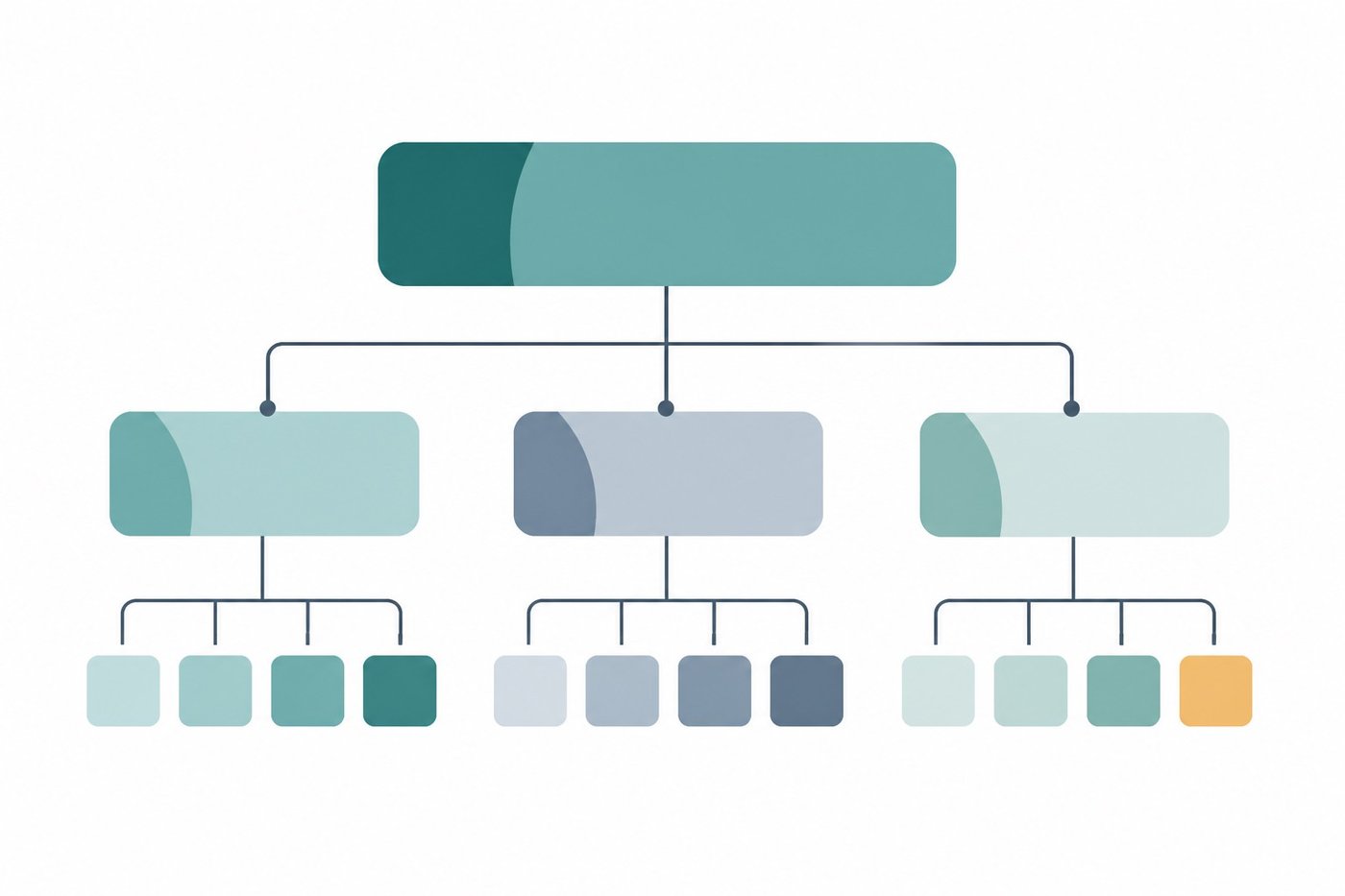
- 1 campaign per objective per market, with campaign-level budget
- 2–4 ad sets inside it, sized so each clears ~50 weekly events
- 3–5 ads per ad set, refreshed on a fixed cadence rather than when someone notices fatigue
- One broad ad set always running as the control
Broad targeting as a permanent control is worth the discipline. It is the only ad set whose results are not contaminated by your own audience assumptions, and when your clever segments stop working, it tells you whether the problem was the segment or the market.
Structure mistakes that look like performance problems
- Too many ad sets on too little budget. The most common cause of "our CPA went up" with no other change.
- Duplicating an ad set to "reset" it. You restart learning and split the data. Editing significantly does the same thing; know which edits reset learning before you make them.
- Audience overlap between ad sets in the same campaign. You bid against yourself and pay the difference.
- Structuring around internal reporting. The delivery system does not care about your org chart, and campaigns built to match it usually fragment badly.
- Rebuilding structure after every restriction. If accounts keep getting restricted, structure is not the cause and restructuring will not fix it — see how to avoid a Facebook ad account ban.
FAQ
How many ad sets should one Facebook campaign have?
As many as your weekly conversion volume can feed to roughly 50 events each, and no more. For most accounts that is two to four.
Does a flat account structure really outperform a deep one?
Flatter structures usually win, but not because flat is inherently better — because flat concentrates events and exits the learning phase. If your volume is large enough that deep segmentation still clears the threshold, depth costs you nothing.
Should each product have its own campaign?
Only if each product has enough conversion volume to sustain its own ad sets. Otherwise group products into one campaign and separate them at the ad level.
Will restructuring reset my learning phase?
Creating new ad sets always does. Campaign-level changes and creative swaps within an existing ad set are less disruptive. Plan restructures for a period when you can absorb a week of unstable delivery.
How many ad accounts can one business have?
Meta grants a limit that grows with spend history. The practical answer is that most advertisers need far fewer than they open.
The short version
Facebook ads account structure is mostly one decision repeated at different levels: concentrate events, or preserve visibility? Concentrate by default — one campaign per objective per market, two to four ad sets each clearing about 50 weekly events, a permanent broad control, and a naming convention you never rewrite. Add complexity only when your volume can pay for it.
