DoubleClick Ad Tracking in 2026: What Replaced It and How Tracking Works Now

DoubleClick Ad Tracking in 2026: What Replaced It and How Tracking Works Now
Search for DoubleClick ad tracking and you will find documentation that stopped being accurate years ago. The DoubleClick brand was retired in 2018, its products were split across three new platforms, and the cookie mechanism the original system depended on has been eroded by browser after browser since.
The tracking did not disappear — it was renamed, restructured, and rebuilt on different plumbing. This guide maps the old names to the current ones, explains what actually changed underneath, and covers what still works if you inherited a stack full of DoubleClick tags.
What happened to DoubleClick
DoubleClick began as an independent ad-serving company in the late 1990s and was acquired by Google in 2008. For the next decade it was the backbone of Google's display advertising and measurement stack.
In 2018 Google retired the brand and reorganised the products into three families. If you are reading old documentation, this is the translation table you need:
|
Old DoubleClick product |
What it is now |
|---|---|
|
DoubleClick Digital Marketing (suite) |
Google Marketing Platform |
|
DoubleClick Campaign Manager (DCM) |
Campaign Manager 360 |
|
DoubleClick Bid Manager (DBM) |
Display & Video 360 |
|
DoubleClick Search (DS) |
Search Ads 360 |
|
DoubleClick for Publishers (DFP) + Ad Exchange |
Google Ad Manager |
|
DoubleClick Studio |
Studio, inside Campaign Manager 360 |
The doubleclick.net domain outlived the brand and is still used for ad serving and measurement calls, which is why the name keeps surfacing in network tabs, consent tools and blocklists long after the products were renamed.
How DoubleClick ad tracking actually worked
The original model is worth understanding, because it explains why so much of it broke.
- An ad served from
doubleclick.netset a third-party cookie in the user's browser. - That cookie carried a pseudonymous identifier that persisted across every site running the same ad infrastructure.
- When the user later reached the advertiser's site, a Floodlight tag fired on the conversion page and reported back.
- Because both the impression and the conversion carried the same third-party identifier, the system could join them deterministically — even across different sites, weeks apart.
Everything depended on step one. A durable third-party cookie was the join key, and view-through attribution in particular was impossible without it.
What changed underneath
Third-party cookies became unreliable
Safari's Intelligent Tracking Prevention and Firefox's Enhanced Tracking Protection have blocked third-party cookies by default for years. Chrome's own plans shifted repeatedly and ended somewhere other than the full deprecation originally announced, but the practical outcome for advertisers is unchanged: you cannot assume a third-party cookie identifier is available for any given user, and the share of traffic where it is has been falling for years.
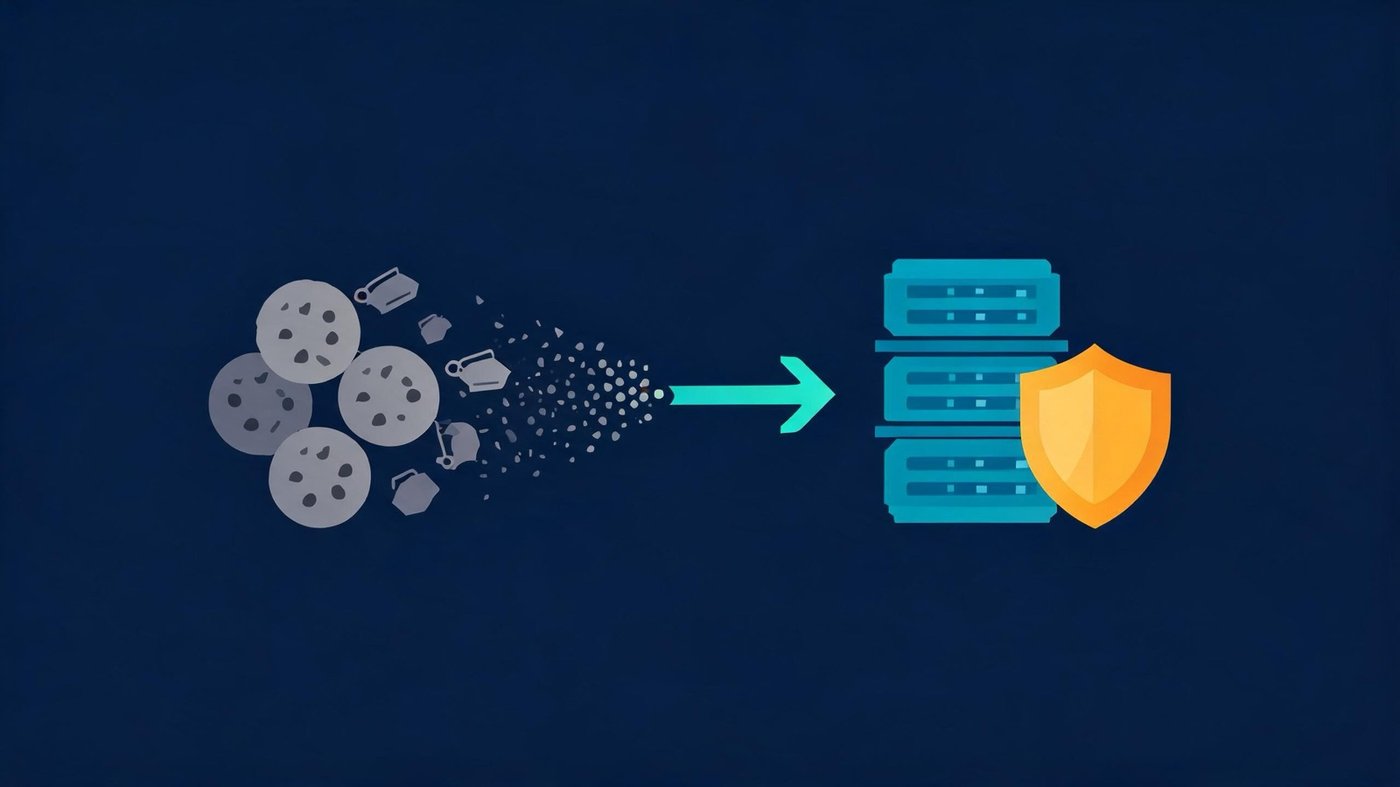
The result is not that tracking stopped. It is that the deterministic join broke for a large share of traffic and was replaced by modelling — conversions that platforms estimate rather than observe.
Floodlight is still here, but it is measured differently
Floodlight tags remain the conversion mechanism in Campaign Manager 360 and Display & Video 360. What changed is what happens after the tag fires: more of the identity resolution now happens through first-party signals, consent-gated identifiers, and Google's own modelling, rather than through a shared cookie.
The tag layer moved first-party
The general industry answer has been to move measurement closer to the advertiser's own domain:
- First-party cookies set by the site itself rather than by an ad domain.
- Server-side tagging, where the browser sends one request to a container the advertiser controls, and that container fans out to vendors.
- Conversions API–style server-to-server posting, sending conversion events from the advertiser's backend rather than the browser.
- Consent Mode, which adjusts tag behaviour based on the consent signal instead of simply not firing.
Attribution windows and reporting got shorter and coarser
With less deterministic identity available, view-through windows carry less weight than they used to, and platform reports increasingly blend observed and modelled conversions. Two platforms reporting different numbers for the same campaign is now the normal state, not a symptom of misconfiguration.
If you inherited a DoubleClick stack
A practical order of operations:
- Inventory what is actually firing. Open the network tab on a conversion page and look for calls to
doubleclick.net,fls.doubleclick.netandgoogleads.g.doubleclick.net. Old Floodlight tags survive redesigns surprisingly often. - Map every tag to a live account. Tags that report into a Campaign Manager account nobody logs into are pure page weight and pure risk.
- Check consent coverage. A tag firing before consent in a jurisdiction that requires it is a compliance problem regardless of whether anyone reads the data.
- Move what you can behind a tag manager, ideally server-side, so the next migration is a configuration change rather than a code release.
- Re-baseline before you compare. Numbers from a cookie-era baseline are not comparable to today's modelled numbers. Comparing them produces false alarms about performance drops.
- Instrument the post-click path separately. Ad platform tags tell you about impressions and conversions. They say very little about what happened between the click and the landing page — redirects, slow pages, geo mismatches and bot filtering all sit in that gap.
That last point is where the biggest measurable losses usually hide, and it is deliberately outside what any ad server was built to report. It is the layer DeepClick instruments, sitting between the ad click and the page that finally renders.
Does DoubleClick ad tracking still work?
Partly, and with caveats. Floodlight tags placed years ago will generally still fire and still report into Campaign Manager 360. What has degraded is the identity layer they depended on: fewer users carry a stable third-party identifier, so more of the reported conversions are modelled and cross-site view-through attribution is far weaker than the original design assumed.
If your tags are old enough to predate the rename, the more urgent question is usually not accuracy but hygiene — whether they are consented, whether anyone reads the reports, and whether they are slowing down the page.
Related reading
For the mobile side of the same problem, see the mobile advertising attribution guide and the mobile measurement partner guide. For link-level tracking design, link tracking for ad campaigns covers UTM and redirect structure.
FAQ
Is DoubleClick still a Google product?
Not under that name. The products were renamed in 2018 and split across Google Marketing Platform and Google Ad Manager. The doubleclick.net domain is still used for serving and measurement.
What replaced DoubleClick Campaign Manager?
Campaign Manager 360, part of Google Marketing Platform. Floodlight remains its conversion tracking mechanism.
Are Floodlight tags obsolete?
No. They are still the conversion mechanism in Campaign Manager 360 and Display & Video 360. What changed is the identity resolution behind them, not the tag itself.
Why do I still see doubleclick.net in my network requests?
Because the domain continues to serve ads and measurement calls regardless of the branding change. Its appearance in a blocklist or consent tool is expected, not a sign of a stale integration.
Should I migrate off DoubleClick-era tags?
Migrate off unmanaged ones. A Floodlight tag reporting into an account you actively use is fine; one left over from an agency relationship that ended three years ago is page weight, a consent liability, and a data leak with no upside.
